.
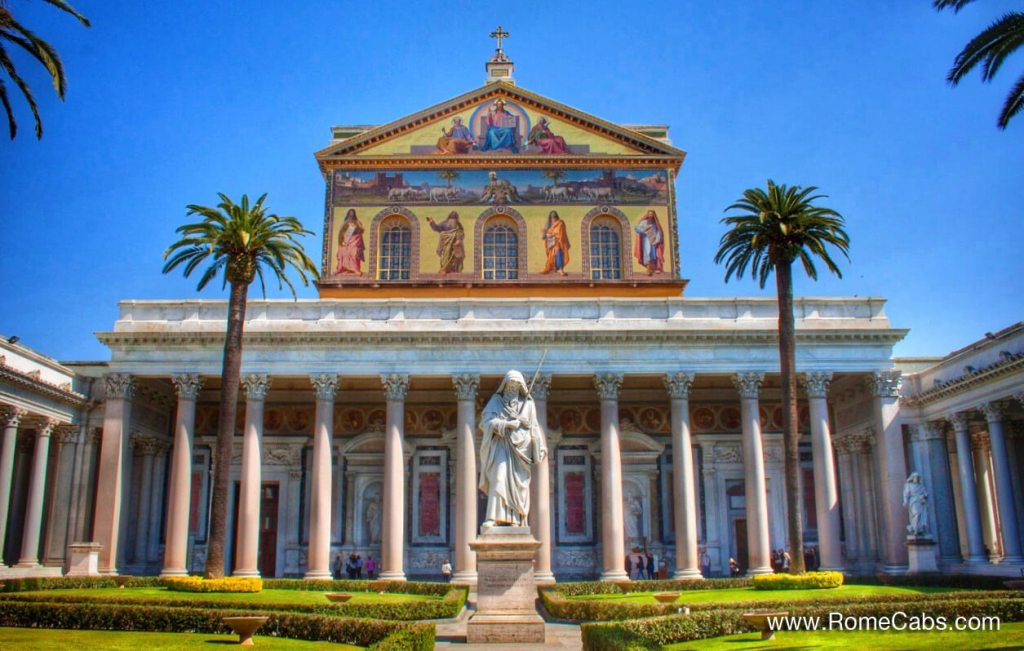
Buongiorno and welcome to RomeCabs Rome Travel Blog! Just outside of Rome along the ancient Roman road, Via Ostiensis stands the Papal Basilica of Saint Paul Outside the Walls, also known in Italian as Basilica Papale di San Paolo fuori le Mura. If you are visiting in Rome for the day on a shore excursion from Civitavecchia, or spending a few days exploring the Eternal City, don’t miss this must-see church in Rome!
This majestic basilica is one of Rome’s four major papal basilicas, alongside Saint John in the Lateran, Saint Peter’s Basilica at the Vatican, and Saint Mary Major (Santa Maria Maggiore), and holds a special place as one of the Seven Pilgrim Churches of Rome. The Basilica received its name “outside the walls” from its location outside of what remains of Rome’s ancient Aurelian Wall.
In this travel blog, we explore the history, architectural grace, and spiritual beauty of the Basilica of Saint Paul Outside the Walls.
.
.
Founding and Evolution of Saint Paul Outside the Walls
At the crossroads of history and spirituality, Saint Paul Outside the Walls stands as a testament to the enduring faith that has woven its way through the ages. The roots of this extraordinary basilica delve deep into the annals of Roman history, tracing back to the visionary Emperor Constantine I, whose reverence for Saint Paul of Tarsus inspired the foundation of this sacred edifice.
Legend whispers of a somber event that unfolded after the execution of Saint Paul—a poignant response from his devoted followers who erected a memorial known as a cella memoriae.
This marked the inception of the first basilica, a humble yet profound structure consecrated in the year 324 by Pope Sylvester. Over the centuries, the basilica underwent a metamorphosis, mirroring the ebbs and flows of both Roman history and Christian devotion.

.
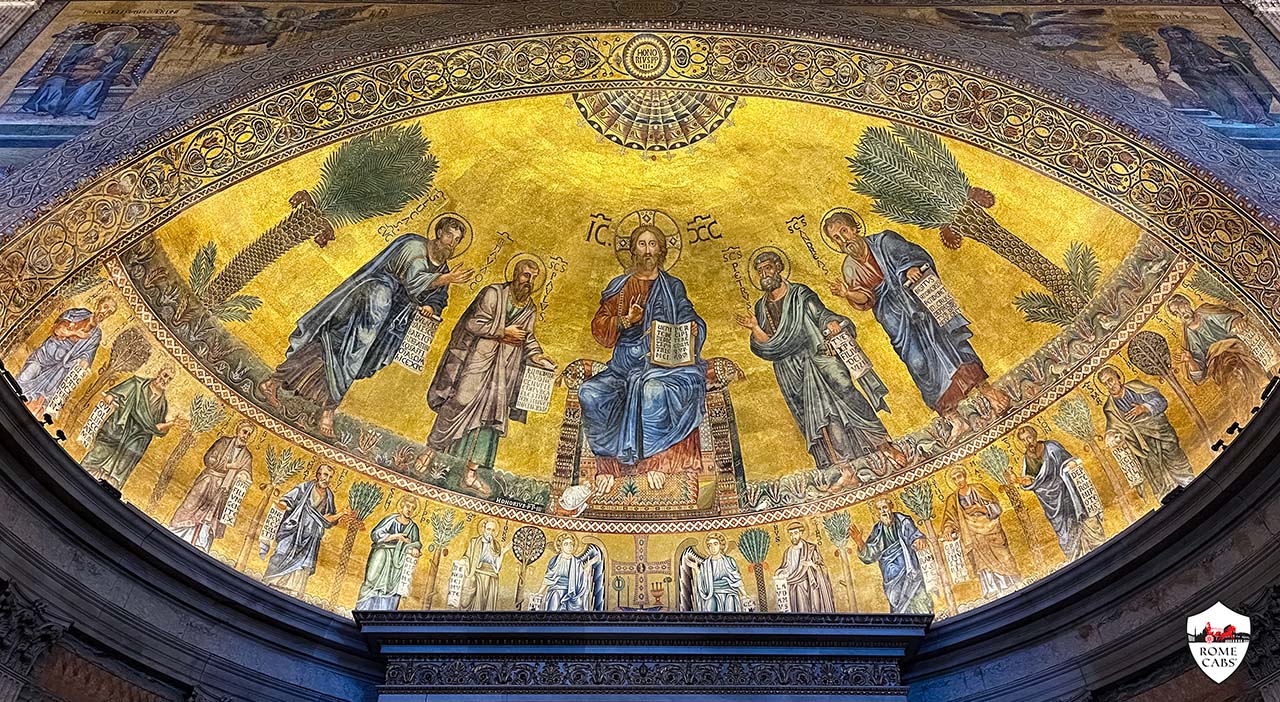
In the year 386, under the patronage of Emperor Theodosius I, the foundations were laid for a more opulent and expansive basilica, destined to be a beacon of Christian splendor. Pope Innocent I consecrated this grandiose structure around 402, heralding a new chapter in the basilica’s storied existence. The beauty of the basilica, with its intricate mosaics and awe-inspiring architecture, reached its zenith during the pontificate of Leo I (440–461).
As the 5th century unfolded, Saint Paul Outside the Walls emerged as a colossus, surpassing even the venerable Old Saint Peter’s Basilica in size (the Old Saint Peter’s Basilica was replaced with the current Saint Peter’s Basilica in the 1500s). This church became a living testament to the grandeur of Christianity, a symbol etched in stone and history. Pilgrims and faithful from far and wide were drawn to the sacred grounds, seeking solace and connection with the divine in this architectural marvel.
.
.
The basilica’s evolution mirrored the evolution of Christian beliefs, surviving fires (see below), earthquakes, and the passage of time. Each renovation and expansion added layers to its spiritual significance, transforming it into a living canvas that encapsulates the journey of Christianity from its early roots to the grandeur of the medieval era.
.
Surviving Fire: Rebuilding Saint Paul Outside the Walls
Saint Paul Outside the Walls has weathered its fair share of challenges throughout its long history, enduring earthquakes, raids, and the inevitable passage of time. Popes Gregory the Great and Leo III were instrumental in the repairs following these incidents.
However, a defining moment occurred in 1823 when a routine roof repair went awry, sparking a devastating fire that almost razed the basilica. Despite widespread destruction, Pope Leo XII led efforts to restore the basilica to its fourth-century glory. The reconstruction, managed by architects Pasquale Belli and later Luigi Poletti, spanned several decades and incorporated salvaged elements from the original structure.
Foreign support played a significant role in the reconstruction. The Italian Government declared the church a national monument, and the entire basilica was reconsecrated in 1854.
This period marked not only the physical reconstruction of Saint Paul Outside the Walls but also a testament to resilience and determination. Today, visitors witness the reconstructed basilica, standing as a symbol of endurance and the indomitable spirit that triumphed over the flames of adversity.
.

.
.
Architectural Marvels of Saint Paul Outside the Walls
The exterior of the basilica showcases a covered portico, a 19th-century addition during reconstruction, and features the Holy Door, opened exclusively during Jubilees, marking significant pilgrimage events.
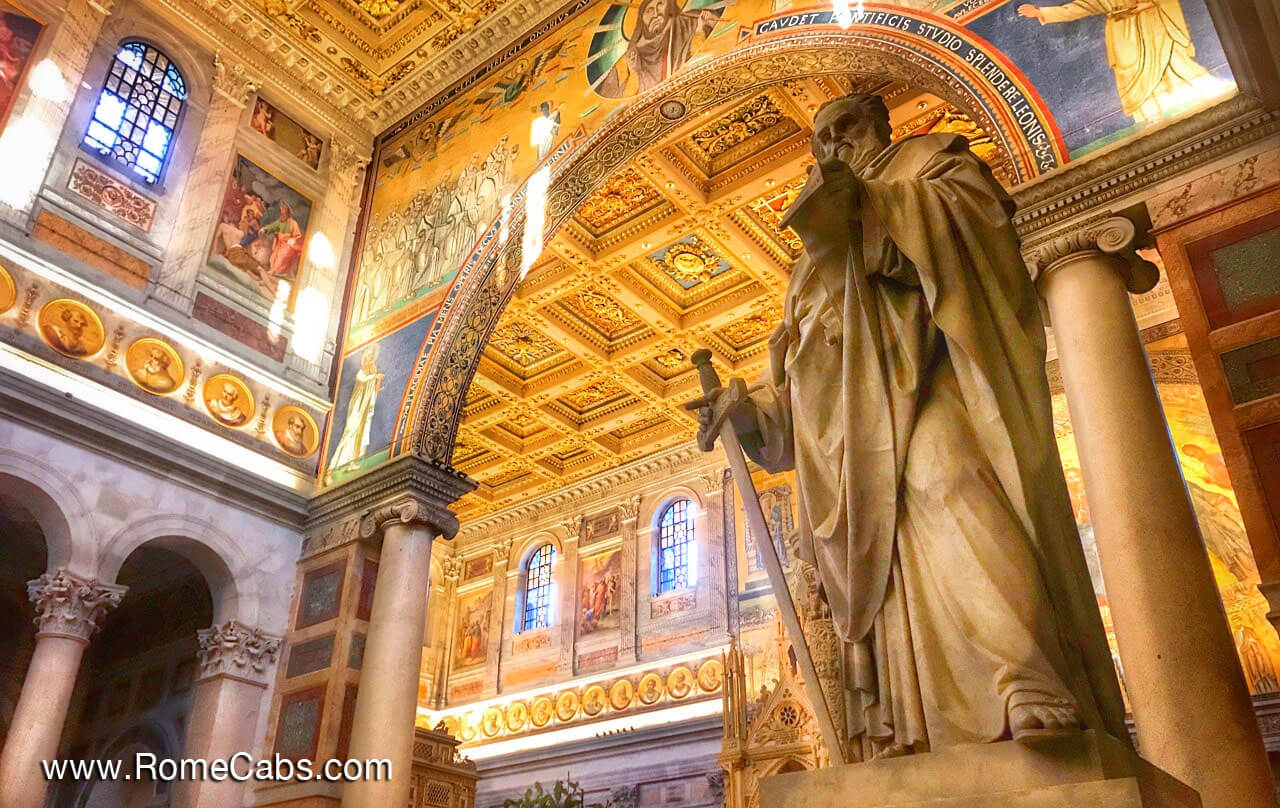
Inside, the basilica maintains its original structure with one nave and four side aisles, making it the second-largest basilica in Rome with dimensions of 131.66 meters in length, 65 meters in width, and a height of 29.70 meters.

.
The nave, supported by 80 columns dating back to the 19th century, boasts a wood and stucco-decorated ceiling that adds to the basilica’s charm. Remnants from the ancient basilica, including 5th-century mosaics on the triumphal arch, contribute to the historical ambiance. The seemingly stained glass windows from the inside are, in fact, crafted from translucent alabaster, casting a soft and serene glow.
Saint Paul Outside the Walls is a testament to meticulous reconstruction efforts while preserving the original structure’s essence. With straightforward elegance, it offers visitors a journey through time, allowing them to witness the intersection of faith and craftsmanship that defines this enduring sanctuary.
.

.
The Tomb of Saint Paul
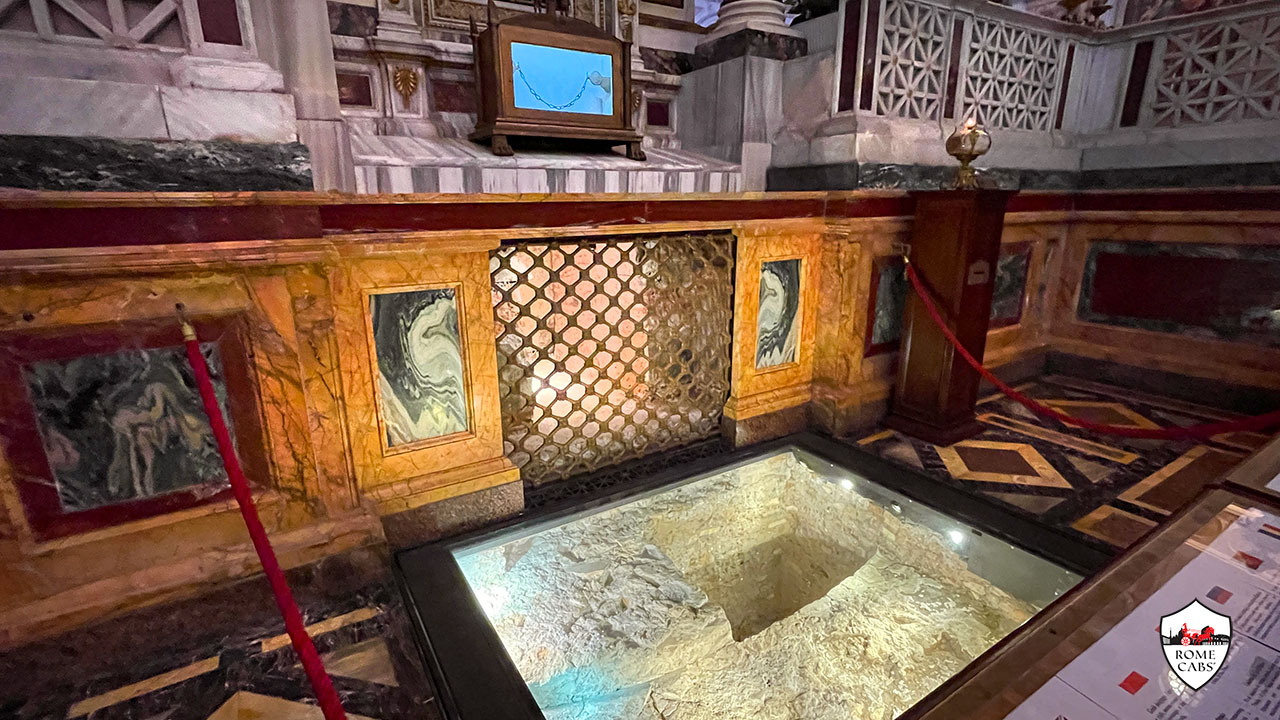
Beneath the solemn expanse of Saint Paul Outside the Walls lies the tomb of Saint Paul, a site of immense historical and religious significance. Tradition dictates that Saint Paul’s remains were laid to rest in this sepulchral area. Recent excavations guided by Vatican archaeologists unveiled a white marble sarcophagus beneath the altar.
.
.
The radiocarbon dating conducted in 2009 lends credence to tradition, suggesting that the bones within may indeed date back to the 1st or 2nd century—an alignment with the longstanding belief that they belong to Saint Paul. This tomb, hidden beneath the basilica’s crypt, stands as a poignant reminder of the sacred history etched in the very foundations of Saint Paul Outside the Walls.
.
Jubilee Door and Entrances of St. Paul Outside the Walls
As pilgrims approach the grand Basilica of St. Paul Outside the Walls in Rome, they are greeted by a stunning façade adorned with five magnificent doors, each telling a story of faith and devotion.
At the center of this architectural masterpiece stands the central door, a masterpiece crafted by the skilled hands of Antonio Maraini. Installed in 1931, this door is a testament to the lives of two revered saints, Peter and Paul, depicted through twelve captivating bronze reliefs. Flanking this central door are statues of the apostles, sculpted by the talented Gregorio Zappalà, immortalizing their legacy for generations to come.
.
.
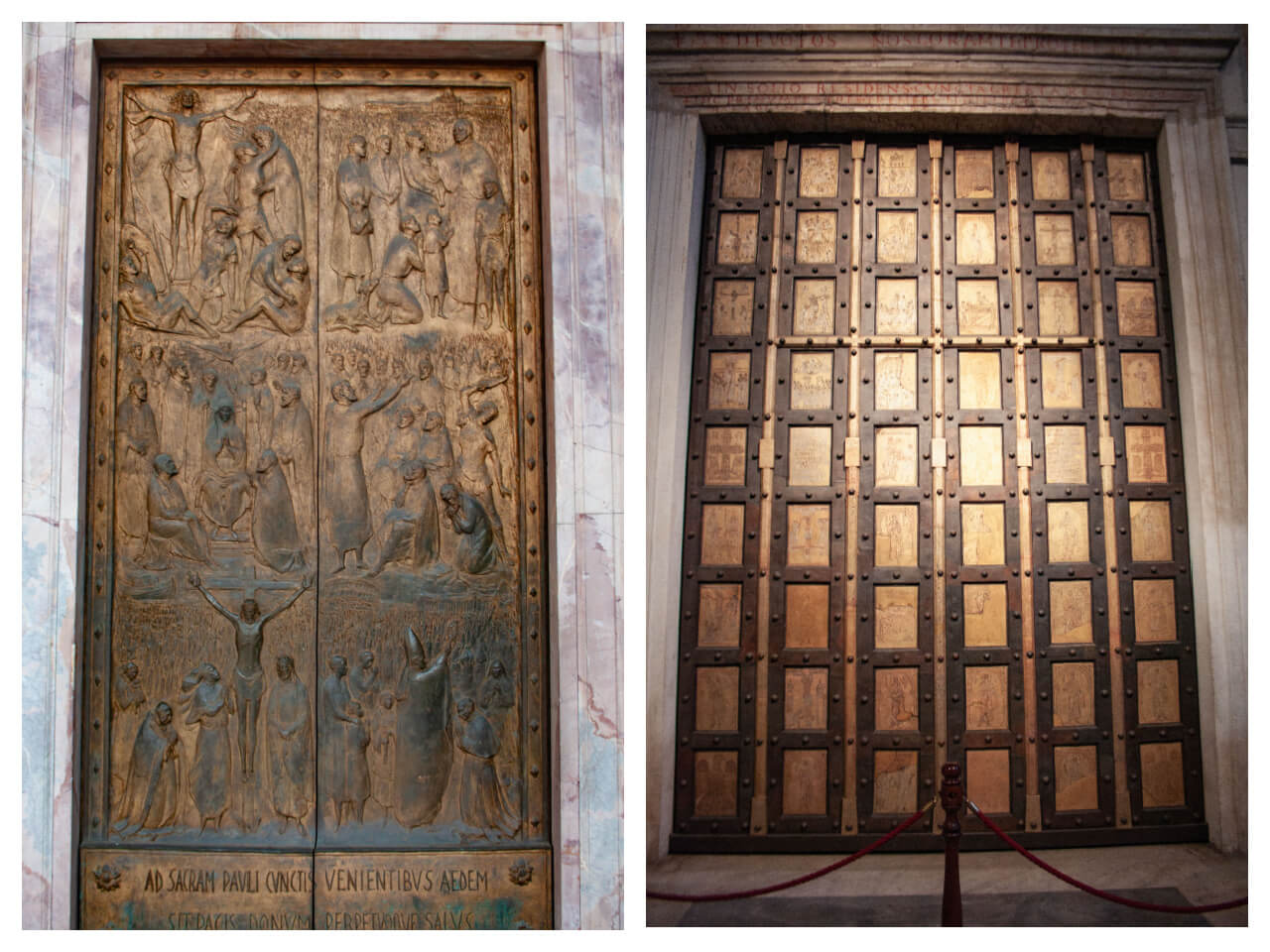
On the right side of the main entrance lies the revered Porta Santa, the Holy Door, a portal reserved for special occasions, particularly during Holy Years. Executed by Enrico Manfrini and installed during the Jubilee of 2000, this sacred doorway symbolizes spiritual renewal and forgiveness for pilgrims who pass through its threshold.
Yet, its significance extends beyond its physical form; on the inside, the Porta Bizantina, dating back to 1070, captivates with its intricate silver inlays, offering a glimpse into centuries of devotion and reverence.
To the left of the central door, the Porta Paolina beckons with its bronze reliefs, crafted by the talented Guido Veroi. Each panel tells a story, inviting visitors to contemplate the profound teachings of Christianity and the enduring legacy of St. Paul.
As pilgrims journey through these sacred entrances, they embark on a spiritual odyssey, guided by the profound symbolism and rich history of the Basilica of St. Paul Outside the Walls.
.
The Cloister of Saint Paul Outside the Walls
Step into the serene retreat of the monastery’s cloister, a testament to medieval craftsmanship erected between 1220 and 1241. The graceful double columns adorned with golden and colored-glass mosaics create a peaceful ambiance. Positioned south of the transept, this cloister is celebrated as one of the most beautiful examples of Middle Ages architecture. Among its pillars, fragments from the original basilica and ancient sarcophagi provide tangible connections to the past, offering a quiet escape into history within the walls of Saint Paul Outside the Walls.
The Basilica of Saint Paul Outside the Walls stands not just as a testament to architectural magnificence but as a living chronicle of Christianity’s journey through time. Its rich history, intricate architecture, and spiritual significance make it a must-visit for pilgrims, history enthusiasts, and those seeking a profound connection with the roots of Christianity in the heart of Rome.
VISITOR INFO FOR BASILICA OF SAINT PAUL OUTSIDE THE WALLS
- Address: Piazzale San Paolo, 1, Rome
- Opening Hours: 7 AM to 6:30 PM
- Entrance Fees: Free to visit the Basilica, tickets required to visit the cloister and archaeological area
- Facilities: Saint Paul Outside the Walls has a cafe, a souvenir/gift shop, and toilets.
- Visitors with Mobility Concerns: The Basilica has ramps in most areas to be accessible by wheelchair users and visitors with mobility concerns.
- Closest Metro Stop: San Paolo, Metro Line
.
DISCOVER MORE MUST-SEE CHURCHES IN ROME:
Santa Maria della Vittoria: A Baroque Masterpiece in the Heart of Rome
Master of Illusions: Sant’Ignazio Church’s Fake Dome and Frescoes
.
HELPFUL ITALY TRAVEL TIPS
10 Common Mistakes that Ruin your Summer Trip to Italy
Rome Safety and Travel Tips: Ensuring a Secure and Enjoyable Visit
5 Great reasons to book private tours in Italy
.
* Find us online also on:
- RomeCabs FACEBOOK
- RomeCabs PINTEREST
- RomeCabs TWITTER
- RomeCabs INSTAGRAM
- RomeCabs FLICKR Photo Gallery
- RomeCabs Recommended on Cruise Critic
.

 RomeCabs Blog Italy - Italy Private Excursions, Rome Tours, Civitavecchia Transfers
Leave a Reply