
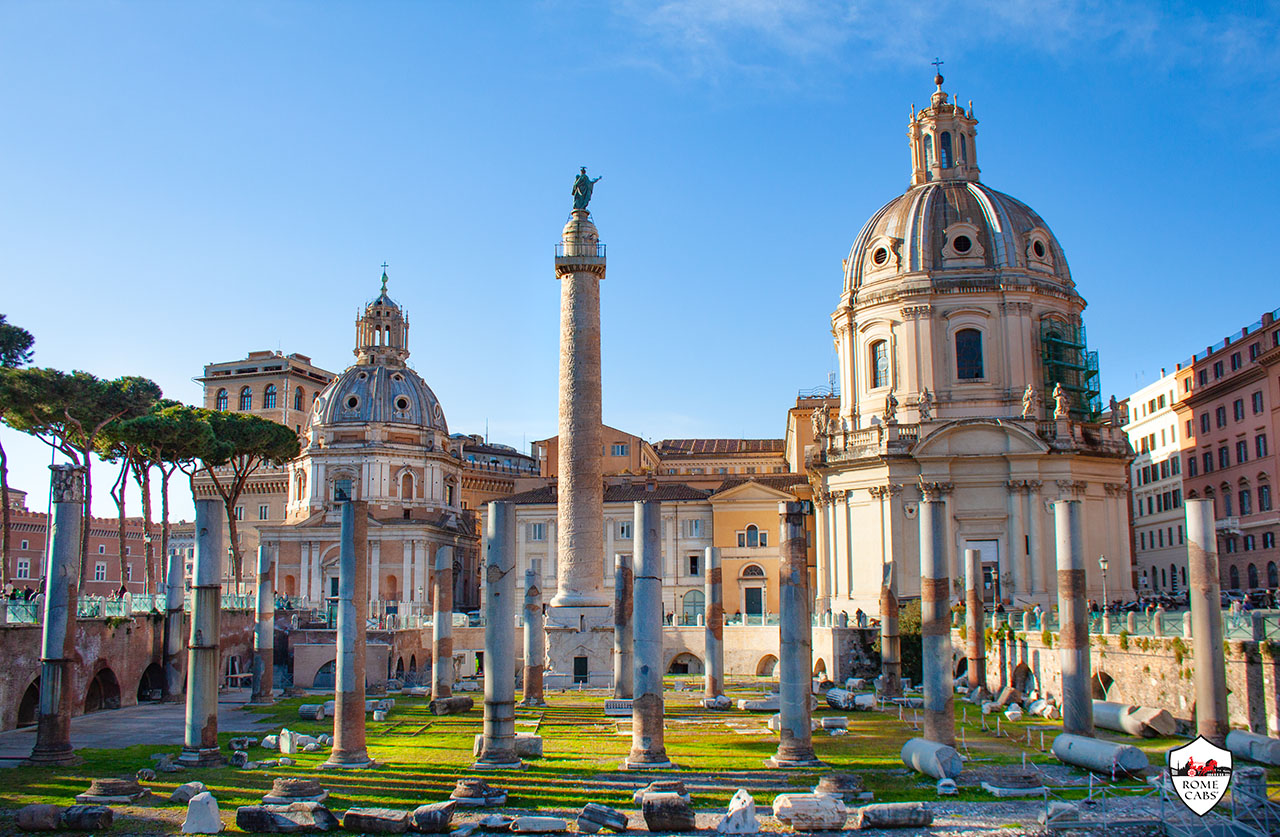
Buongiorno and welcome to the RomeCabs Rome Travel blog! Trajan’s Column is a towering emblem of Rome’s imperial grandeur, a remarkable architectural and artistic achievement that has intrigued historians, artists, and travelers for centuries. Completed in 113 AD during the illustrious reign of Emperor Trajan, this iconic monument stands as more than just a marvel of Roman engineering; it serves as a monumental testimony to Roman military prowess and Trajan’s enduring legacy.
In this blog, we will delve into the life of Emperor Trajan, explore the details of the Dacian Wars that he famously led, examine the intricate spiral frieze that adorns his column, and uncover the broader significance of this monumental triumph.
.
.
Who was Emperor Trajan? – His Life and Legacy
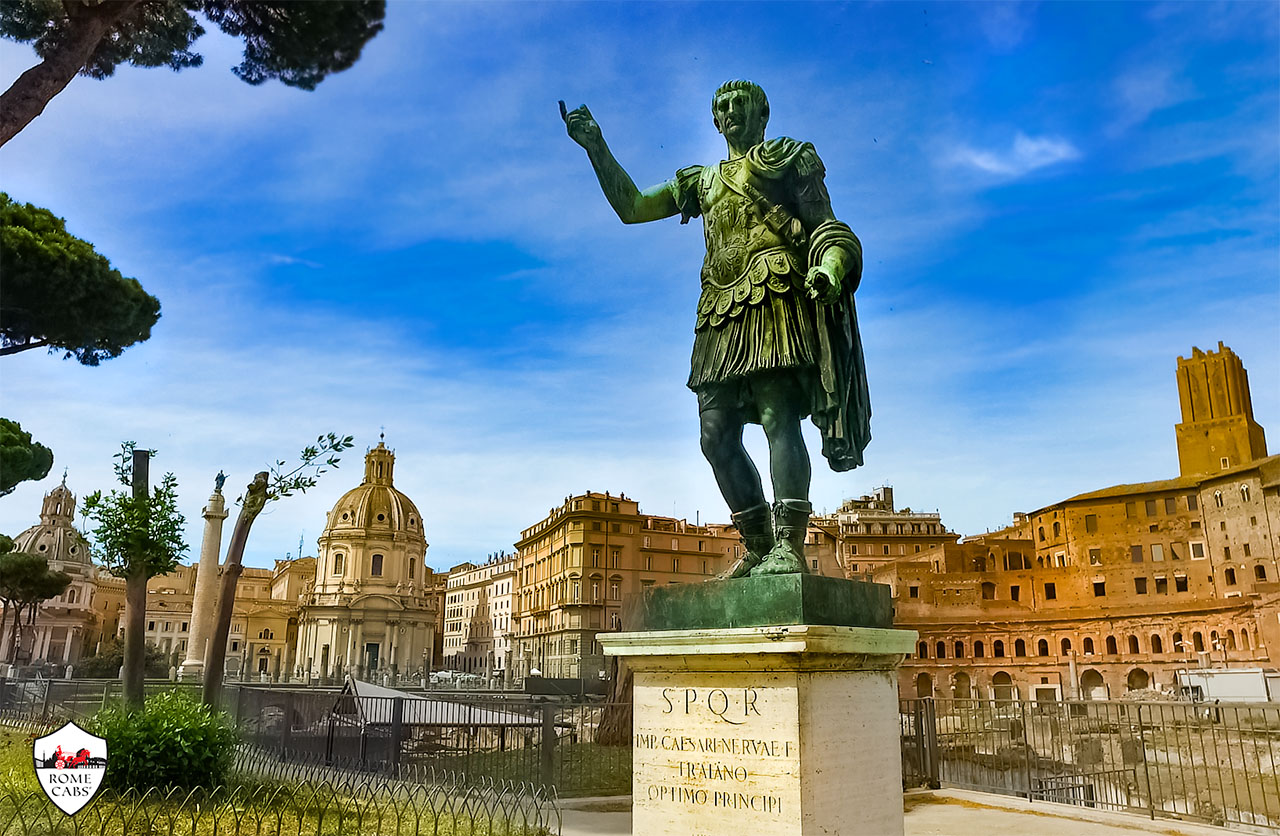
Trajan, born Marcus Ulpius Traianus in 53 AD, was one of the most esteemed emperors of ancient Rome, ruling from 98 AD until his death in 117 AD. Hailing from a respected Roman family in the province of Hispania (modern-day Spain), Trajan was the first Roman emperor born outside Italy, symbolizing the growing diversity within the empire’s leadership. His military conquests are his most enduring legacy, particularly the successful campaigns against Dacia, which expanded the Roman Empire to its greatest territorial extent.
The Dacian Wars, fought between 101 and 106 AD, were pivotal during Trajan’s reign, leading to the annexation of Dacia (modern-day Romania) and the influx of vast wealth into Rome, especially through the acquisition of Dacia’s rich gold mines. These wars not only secured Rome’s northern borders but also demonstrated Trajan’s strategic genius and cemented his reputation as one of Rome’s greatest military leaders.
.

.
Beyond his military achievements, Trajan was celebrated for his administrative efficiency and his extensive public works. He initiated numerous construction projects across the empire, including the renowned Trajan’s Forum, a monumental complex that became a centerpiece of Roman public life. His most famous commemorative monument, Trajan’s Column, vividly depicts the Dacian campaigns and stands as a lasting testament to his victories and contributions to Rome’s urban grandeur.
Trajan’s reign is often considered a pinnacle of Rome’s power and prosperity. His leadership, marked by a blend of military might, civic development, and humane governance, earned him a place among the “Five Good Emperors“. Trajan’s policies, particularly his emphasis on infrastructure and public welfare, set a standard for future emperors and left a lasting legacy as a model of effective and benevolent leadership in the Roman Empire.
.
.
Trajan’s Victory in the Dacian Wars
The Dacian Wars were pivotal in Rome’s expansionist history, as they targeted the Dacians, a formidable and strategically crucial people. Under the leadership of their king, Decebalus, the Dacians had long been a persistent threat to the Roman Empire, engaging in conflicts that challenged Rome’s dominance over the eastern provinces.
The column’s intricate frieze provides a detailed visual narrative of these wars, beginning with the Roman preparations and tactical maneuvers, progressing through the intense battles, and culminating in the eventual defeat of the Dacians. The scenes emphasize the might and organization of the Roman military, highlighting their engineering prowess in constructing fortifications, bridges, and siege machinery, alongside their disciplined approach to warfare.
The outcomes of the Dacian Wars were significant and far-reaching. The conquest resulted in the fall of Decebalus and the incorporation of Dacia as a Roman province, which brought immense wealth to the empire, particularly through the acquisition of Dacia’s rich gold mines.
This newfound wealth fueled further imperial projects and reinforced Rome’s control over the Danube frontier, securing its northern borders. Trajan’s victory not only solidified his status as a formidable military leader but also ushered in a period of relative peace and prosperity for the empire.
Thus, Trajan’s Column stands as a monument not just to a specific military triumph but to the broader ideals of Roman power, military excellence, and the empire’s relentless pursuit of expansion. It is a lasting tribute to Trajan’s leadership, celebrating Rome’s supremacy and serving as a powerful symbol of the emperor’s legacy.
.

.
Architectural Excellence and Materials Used in Trajan’s Column
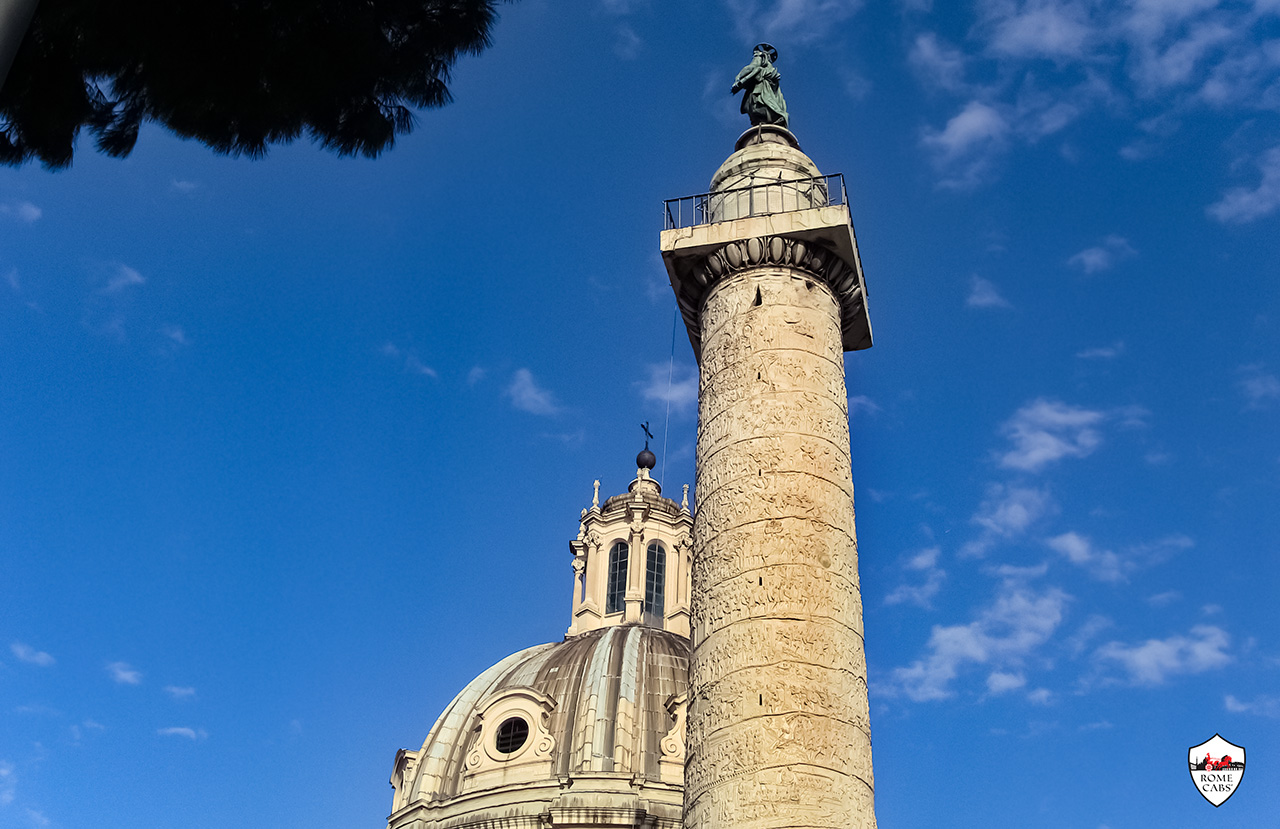
Crafted from pristine Carrara marble—a material renowned for its durability and fine grain—the column’s construction showcases the Romans’ mastery of architecture and sculpture. Carrara marble, quarried from the Apuan Alps in Tuscany, was a favored medium in Rome for its purity and ability to hold fine detail, making it the perfect choice for the intricate carvings that adorn the column. The column’s shaft is composed of 19 massive drums of marble, each weighing approximately 40 tons, meticulously stacked and secured with a central core made of brick and concrete.
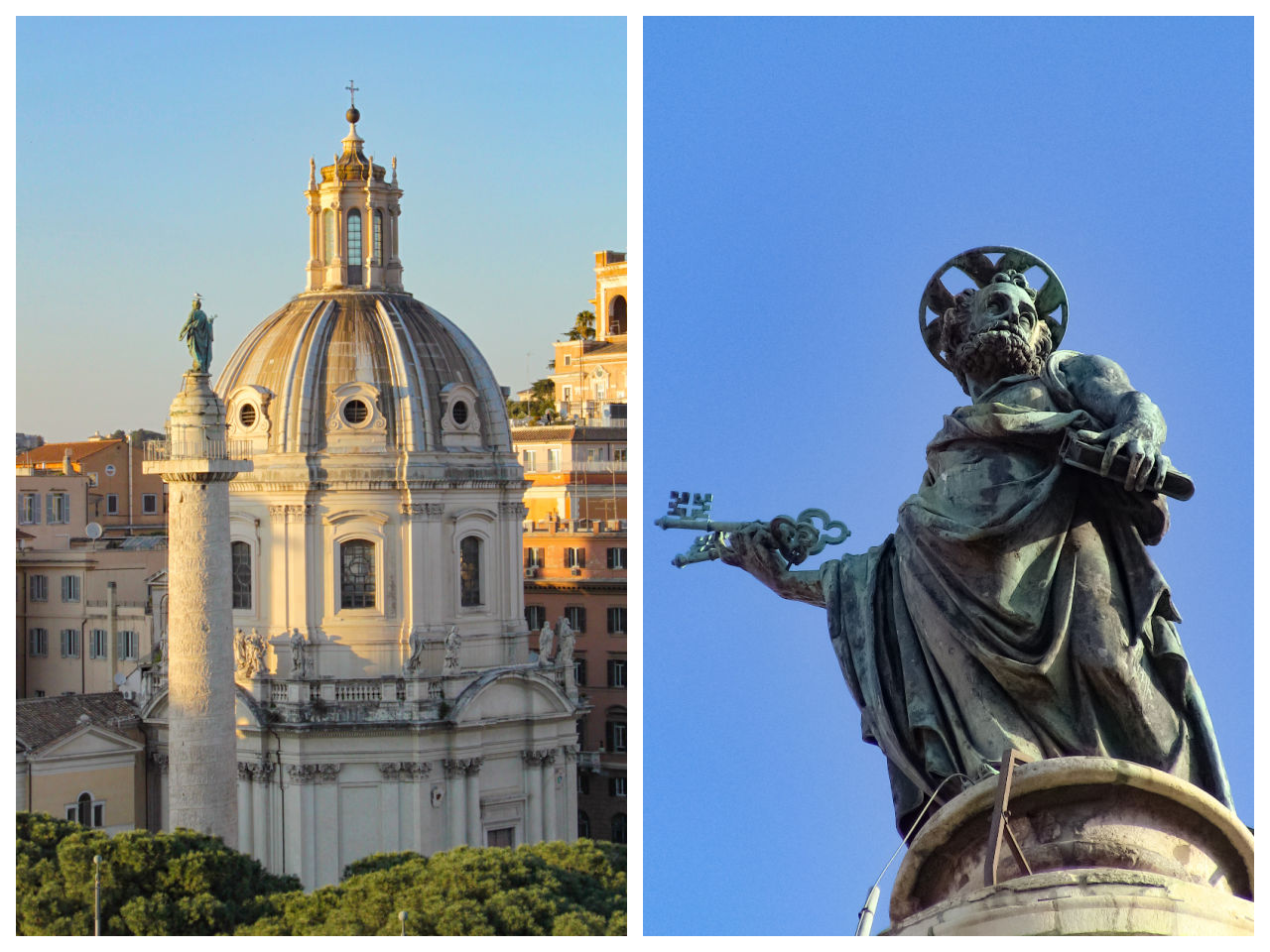
The column is crowned by a platform that originally supported a bronze statue of Emperor Trajan. This statue, lost to history, was later replaced by a statue of Saint Peter in the 16th century, symbolizing the shift from Roman paganism to Christianity. The pedestal, nearly 6 meters (20 feet) in height, contains a chamber believed to have housed the ashes of Trajan and his wife Plotina, making the column not only a victory monument but also a personal mausoleum.
.
.
.
Trajan Column’s Spiral Frieze: A Masterpiece of Narrative Art
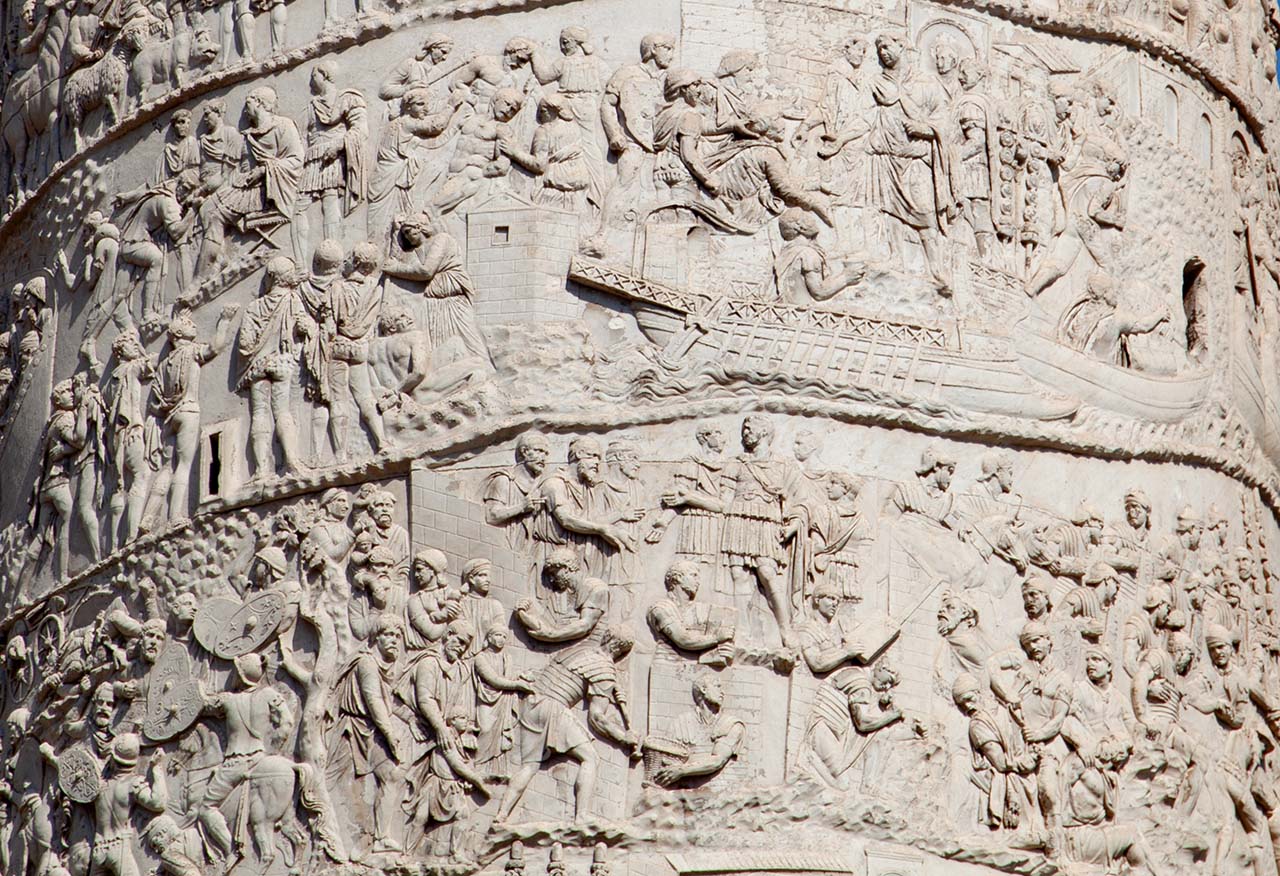
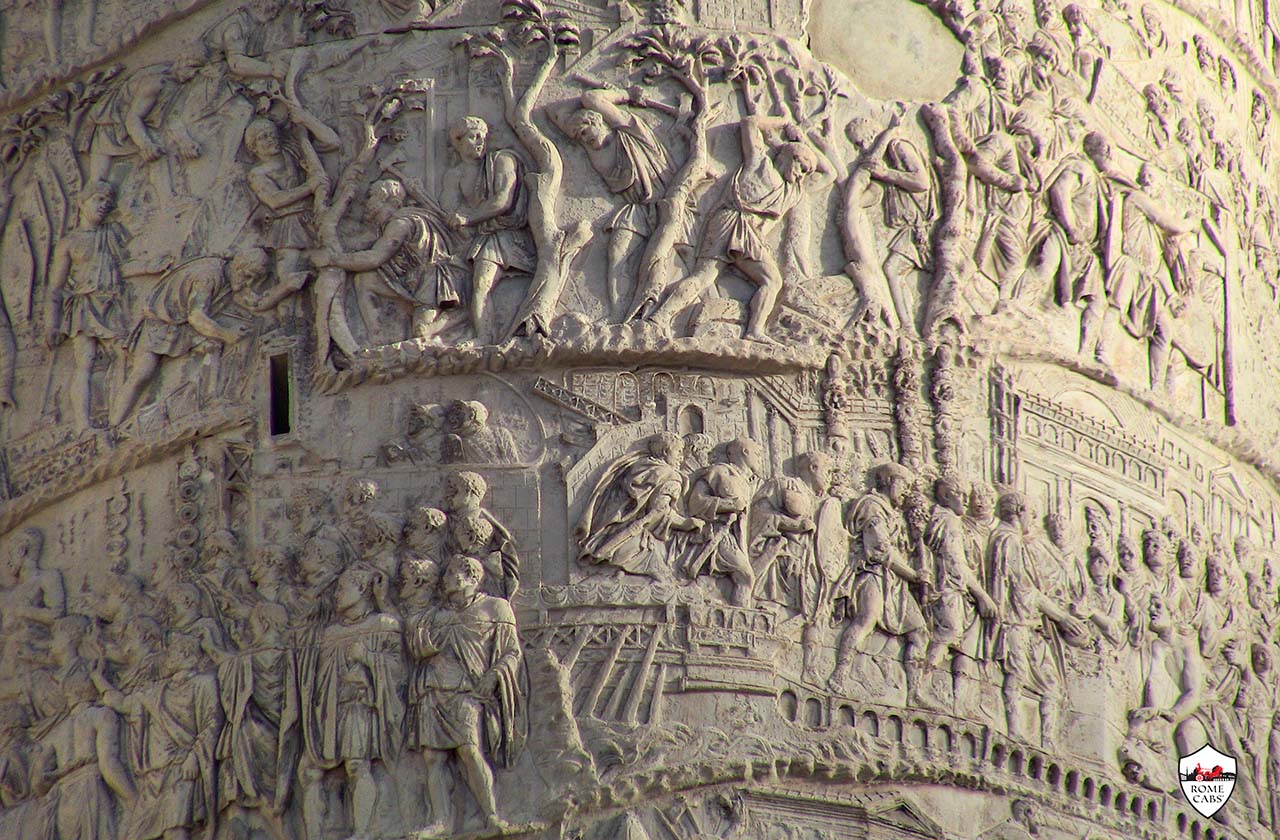
What sets Trajan’s Column apart from other monuments is its extraordinary spiral frieze, an unbroken band of reliefs that spirals around the shaft 23 times, extending to a length of about 200 meters (656 feet) if unfurled. This frieze is an unparalleled example of Roman narrative art, offering a detailed account of the Dacian Wars.
The frieze features 155 scenes, populated by over 2,600 figures, depicting a vivid and dynamic chronicle of the Roman campaigns against the Dacians, a formidable enemy from the region that is now modern-day Romania. The story begins at the base of the column and ascends in a continuous ribbon of action that details the preparation for war and the brutal battles that ensued.
.
.
One of the most striking aspects of the frieze is the depiction of Emperor Trajan himself. He appears repeatedly throughout the narrative, engaged in various activities that underscore his role as both a leader and a soldier. Whether addressing his troops, overseeing the construction of fortifications, or participating in battle, Trajan is portrayed as a calm and authoritative figure, embodying the virtues of the ideal Roman emperor. This recurring imagery served not only to glorify Trajan’s military achievements but also to reinforce his image as a wise and just ruler, a protector of the Roman state.
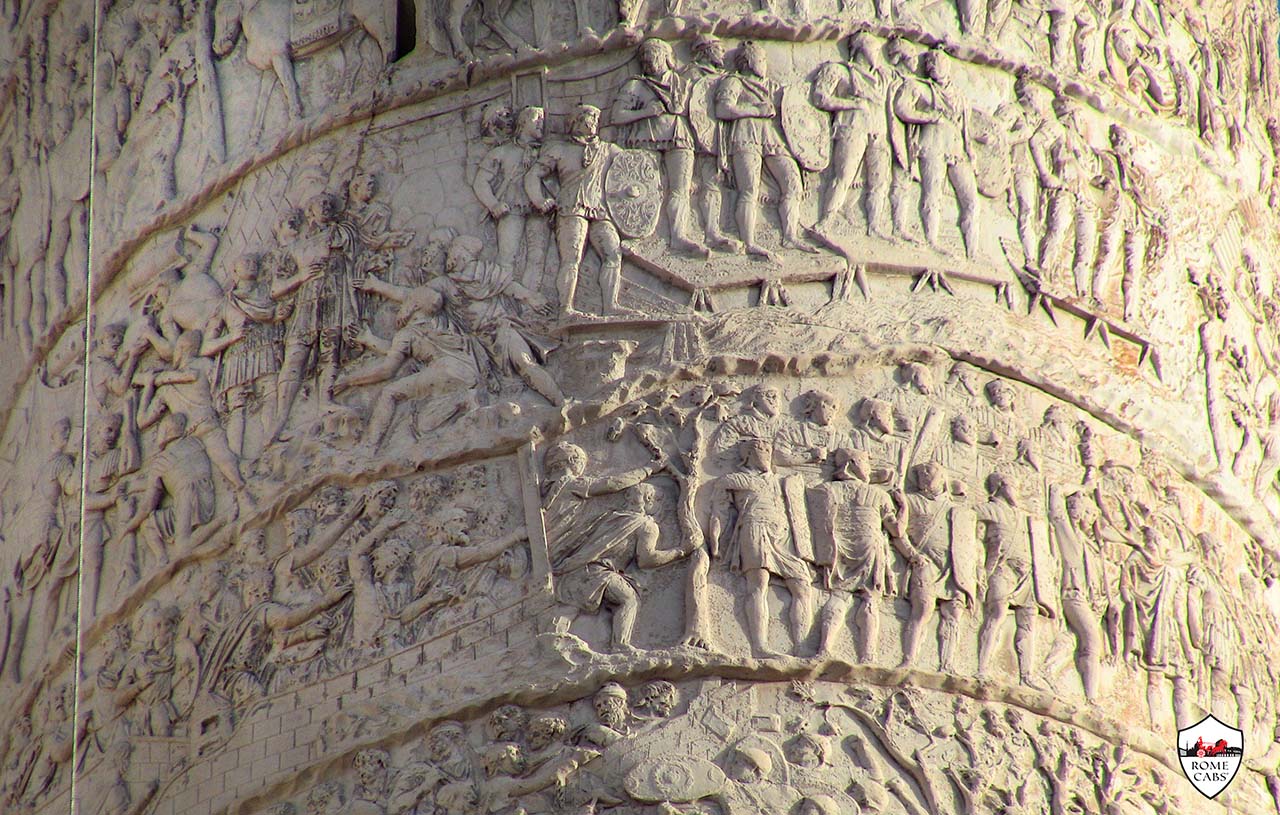
The level of detail in the frieze is astounding. Roman soldiers are depicted with remarkable accuracy, their armor, weapons, and military tactics meticulously carved into the marble. The artists also paid close attention to the portrayal of the Dacians, who are shown with their distinctive clothing, hairstyles, and weapons, providing a nuanced depiction of Rome’s adversaries.
.
.
.
Imperial Propaganda and Cultural Significance
Trajan’s Column is more than just a historical record; it is a potent piece of imperial propaganda. The column’s narrative celebrates Rome’s military prowess and the emperor’s leadership, serving to legitimize Trajan’s rule and immortalize his achievements. The depiction of the Dacians, while detailed and respectful, ultimately underscores their defeat at the hands of the Romans, reinforcing the image of Rome as an unstoppable force.
The column also holds significant cultural and political symbolism. The original statue of Trajan atop the column would have symbolized his eternal presence and surveillance over his empire.
The replacement of this statue with that of Saint Peter in the 16th century signified a shift in the cultural and religious landscape of Rome, from a center of pagan worship to the heart of Christendom. This change marked the integration of the column into the Christian religion of Rome, transforming it from a symbol of imperial power to one of religious authority.
.
.
.
Preservation and Legacy of Trajan’s Column
Remarkably, Trajan’s Column has survived the ravages of time relatively intact, thanks in part to its central location in Rome’s Forum and the enduring admiration it has inspired throughout history. The column’s preservation is a testament to the durability of Roman engineering and the reverence later generations have had for this monument.
Today, Trajan’s Column continues to be a source of inspiration and study. Its detailed frieze provides invaluable insights into Roman military practices, artistic conventions, and the political climate of the time. Scholars and archaeologists have long studied the column to gain a deeper understanding of the Roman Empire, and it remains a popular subject in art history due to its sophisticated narrative techniques and stylistic execution.
.
.
The column’s influence extends beyond academia. Its spiral frieze has inspired numerous works of art, architecture, and literature throughout the centuries. The concept of a column adorned with a continuous narrative relief was emulated in later monuments, such as the Column of Marcus Aurelius in Rome and the Vendôme Column in Paris, demonstrating the enduring legacy of Trajan’s Column in the Western artistic tradition.
Trajan’s Column stands as a monumental record of one of Rome’s greatest emperors and a pivotal moment in the history of the Roman Empire. Its architectural brilliance, combined with its rich narrative frieze, makes it a unique blend of art, history, and propaganda. As a symbol of Roman power, cultural identity, and artistic achievement, Trajan’s Column remains an enduring testament to the grandeur of ancient Rome, continuing to captivate and educate generations of viewers from around the world.
.
What to See Near Trajan’s Column
When visiting Trajan’s Column, you’re stepping into the heart of ancient Rome, surrounded by a wealth of historical and architectural treasures that tell the story of the empire’s grandeur. Here are some of the must-see sights near Trajan’s Column that will enhance your experience and provide a deeper understanding of Rome’s imperial legacy:
.
1. Trajan’s Forum
Adjacent to Trajan’s Column is Trajan’s Forum, an architectural marvel and the last of the great imperial forums constructed in ancient Rome. Built under the supervision of the renowned architect Apollodorus of Damascus, this expansive complex once served as a vibrant hub of Roman political, commercial, and social life.
The forum was home to the Basilica Ulpia, a vast civic space used for legal proceedings and public gatherings, and the Markets of Trajan, a multi-level commercial center that some consider to be the world’s oldest shopping mall. Exploring Trajan’s Forum offers a fascinating glimpse into the daily life and administrative workings of ancient Rome.
.

.
2. The Markets of Trajan
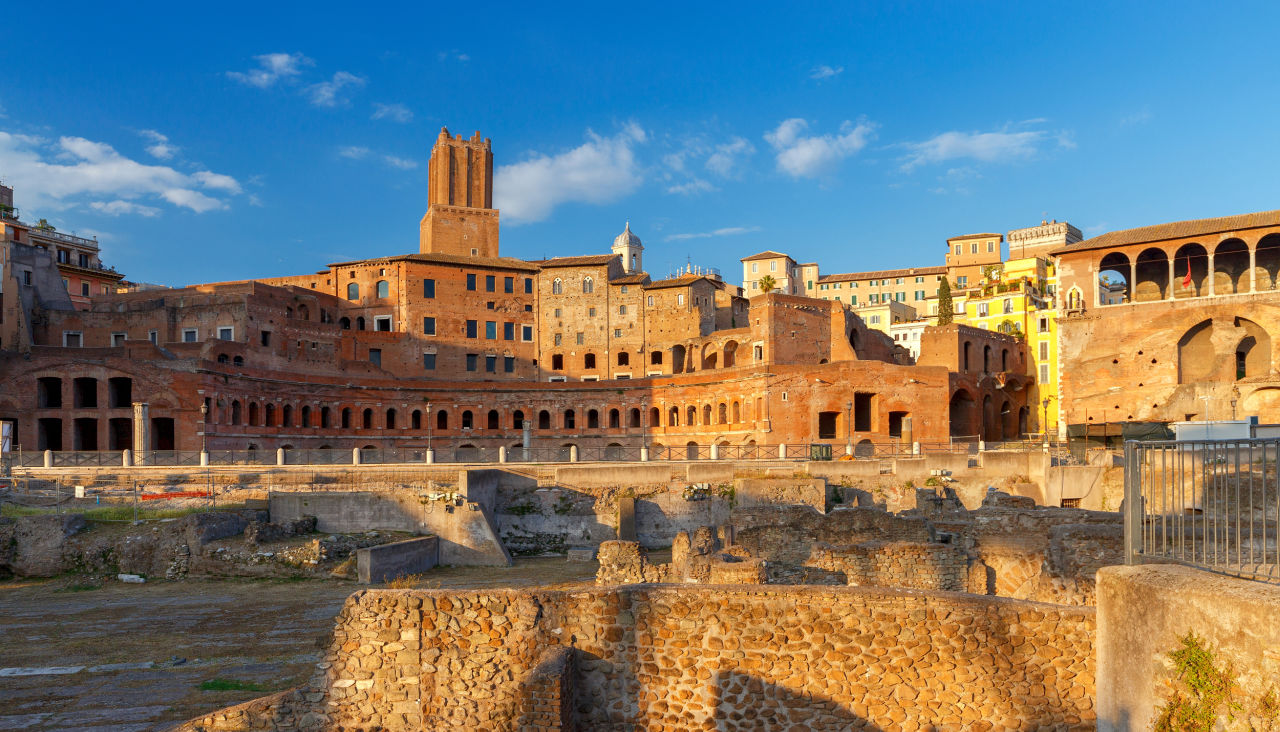
Part of the Trajan’s Forum complex, the Markets of Trajan are an architectural feat of Roman engineering. This semi-circular structure, with its multiple levels of shops and offices, is a testament to the sophistication of Roman urban planning.
The markets were designed to complement the grandeur of the forum, providing a bustling commercial space that catered to the needs of Rome’s citizens. Today, the structure houses the Museum of the Imperial Forums, where visitors can explore ancient artifacts, reconstructions, and exhibits detailing the history of Rome’s forums.
.
.
3. The Roman Forum
A short walk from Trajan’s Column lies the Roman Forum, the epicenter of public life in ancient Rome. This sprawling archaeological site is home to some of the most iconic ruins in Rome, including the Temple of Saturn, the Arch of Septimius Severus, and the Rostra, where speeches were delivered to the public.
The Roman Forum was the beating heart of the Roman Republic and later the Empire, serving as a venue for religious, political, and social activities. Walking through this historical site, you can almost feel the echoes of Rome’s storied past.
.

.
4. The Capitoline Hill
Overlooking the Roman Forum, the Capitoline Hill is one of the Seven Hills of Rome and has been a significant site since ancient times. Today, it is home to the Capitoline Museums, where a vast collection of Roman art, sculpture, and historical artifacts are on display.
The Piazza del Campidoglio, designed by Michelangelo, is a Renaissance masterpiece that offers stunning views of the city and the surrounding ruins. The Capitoline Hill was a key religious and political center in ancient Rome, and its museums provide a deeper understanding of the empire’s cultural and historical heritage.
.
.
5. The Palatine Hill
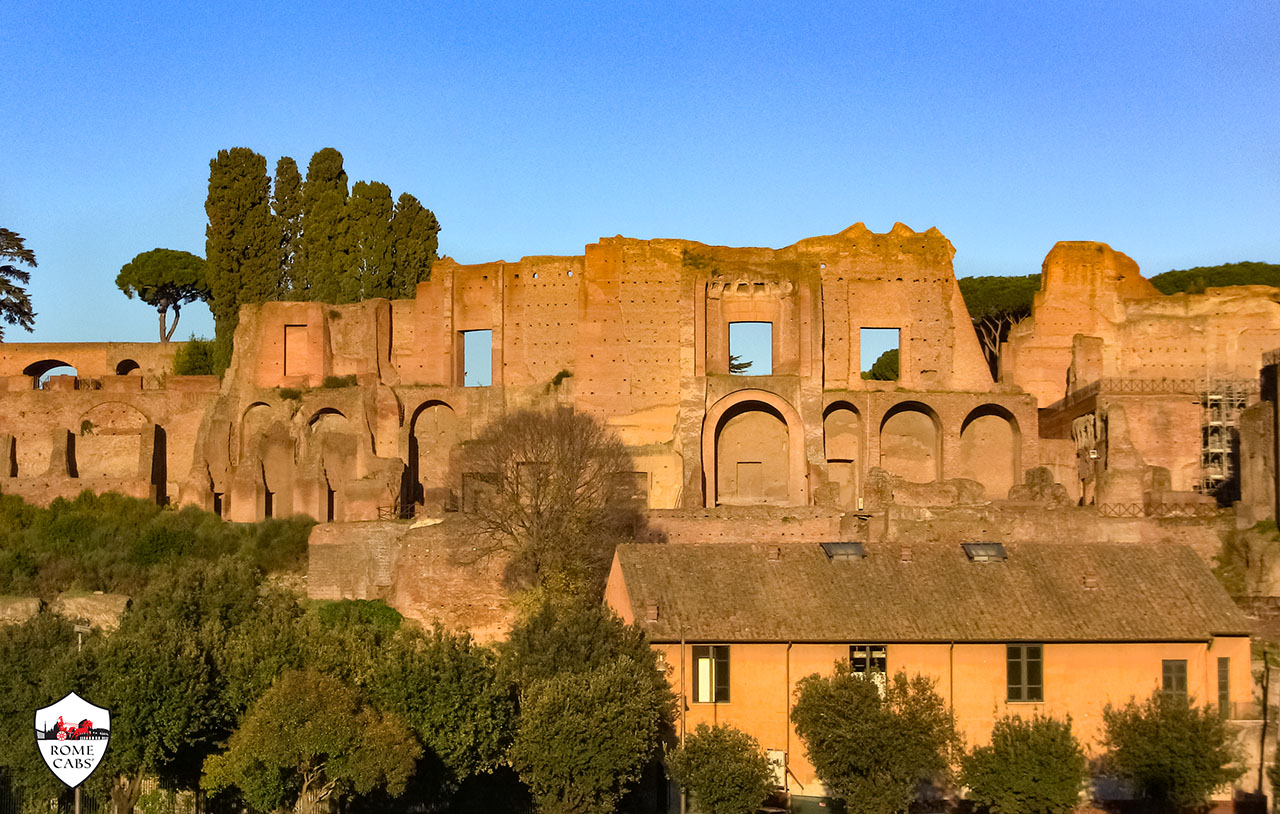
Another nearby attraction is the Palatine Hill, one of the most ancient parts of the city and the legendary birthplace of Rome, where Romulus is said to have founded the city in 753 BC. The hill is home to the ruins of several imperial palaces, including the House of Augustus and the Flavian Palace, which offer insight into the opulent lifestyles of Rome’s emperors.
The Palatine Hill also provides some of the best panoramic views of the Roman Forum and the Circus Maximus, making it a must-see for any visitor interested in Rome’s early history.
.
6. The Colosseum
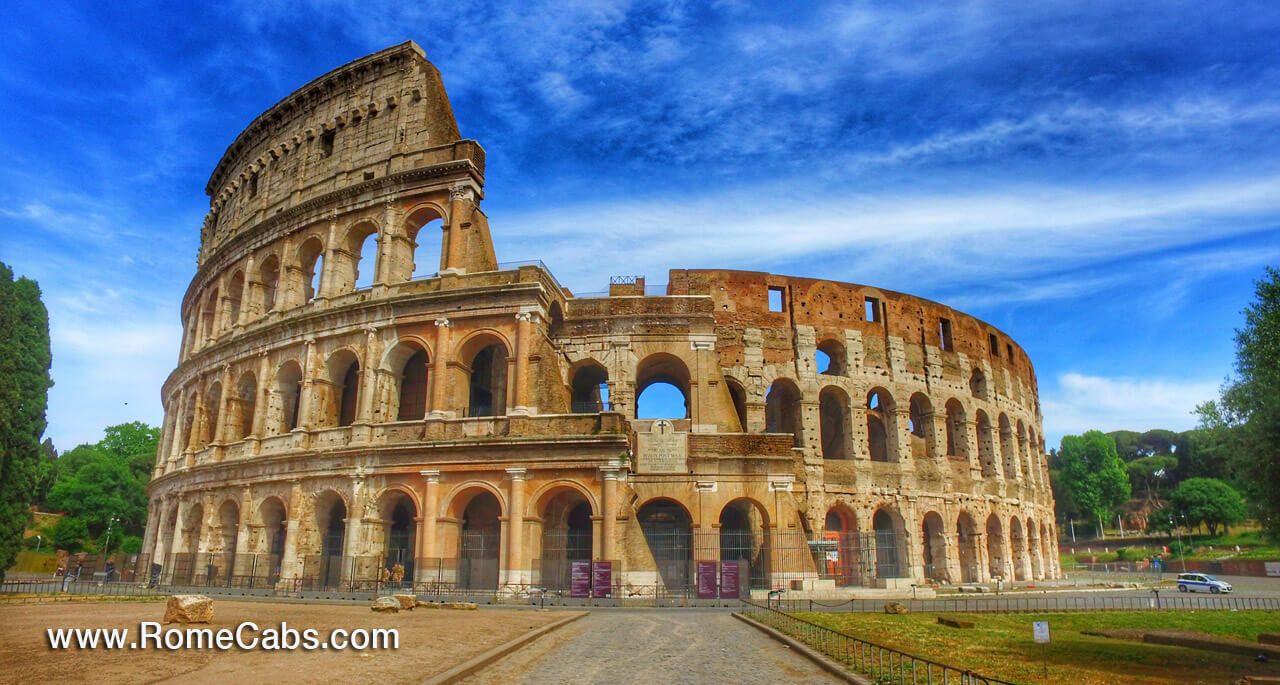
Just a short distance from Trajan’s Column stands the Colosseum, arguably the most famous symbol of ancient Rome. This massive amphitheater, capable of holding up to 80,000 spectators, was the site of gladiatorial games, animal hunts, and other public spectacles. A visit to the Colosseum offers an unparalleled glimpse into the entertainment culture of ancient Rome, as well as the architectural ingenuity that made such a structure possible.
The nearby Arch of Constantine, a triumphal arch commemorating Constantine’s victory at the Battle of Milvian Bridge, adds to the historical significance of the area.
.
.
7. The Vittoriano (Altare della Patria)
Also known as the Altar of the Fatherland, this massive monument dedicated to Victor Emmanuel II, the first king of a unified Italy, is located just a few minutes from Trajan’s Column.
The Vittoriano is a striking example of neoclassical architecture and serves as a symbol of Italy’s national identity. Visitors can explore the museum housed within the monument, which chronicles the history of Italian unification, or take an elevator to the top for breathtaking views of Rome’s historic center.
.

.
These nearby attractions, each steeped in history and cultural significance, make the area around Trajan’s Column one of the richest and most rewarding places to explore in Rome. Together, they provide a comprehensive picture of the grandeur of the Roman Empire and its lasting impact on the world.
In summary, Trajan’s Column stands as a remarkable testament to the grandeur and complexity of ancient Rome. More than just an architectural marvel, it encapsulates the military triumphs and strategic brilliance of Emperor Trajan, offering a vivid portrayal of the Dacian Wars and the heights of Roman imperial power.
Whether you’re a history enthusiast, an art lover, or simply a curious traveler, Trajan’s Column offers an unparalleled glimpse into Rome’s majestic past.
We hope this blog has provided you with a deeper appreciation of this iconic monument and its enduring legacy in the heart of the Eternal City. Thank you for joining us on this journey through Rome’s rich history, and we look forward to sharing more of Rome’s timeless treasures with you.
.
Find RomeCabs online also on:
- Facebook: https://www.facebook.com/RomeCabsToursAndTransfers
- RomeCabs Pinterest: https://www.pinterest.it/romecabs
- RomeCabs Twitter: https://twitter.com/RomeCabs
- RomeCabs Instagram: https://www.instagram.com/romecabs/
- RomeCabs Flickr Photos: https://www.flickr.com/photos/romecabs/
- More Travel Blogs: https://romecabsdotnet.wordpress.com/
.
.
.
.
.

.
.
.
 RomeCabs Blog Italy - Italy Private Excursions, Rome Tours, Civitavecchia Transfers
Leave a Reply