
Buongiorno and welcome to RomeCabs Rome Travel Blog! Rome is a city that thrives on its timeless blend of ancient monuments, Renaissance art, Baroque splendor, and vibrant streets. For travelers who are short on time but still want to see the highlights of this remarkable city, the RomeCabs Panoramic Tour is an ideal option.
This luxurious, private tour by car allows you to explore Rome’s most famous landmarks comfortably, without the stress of waiting in long lines or dealing with large crowds.
Panoramic Rome Tour: A Luxurious Exploration of Rome’s Most Iconic Sites
The RomeCabs Panoramic Tour provides an effortless and enjoyable way to explore Rome’s most iconic landmarks, making it the ideal choice for travelers with limited time who want to experience the best of the Eternal City without the hassle of long lines and crowded tourist spots.
With a private vehicle and a flexible itinerary, you can take in the grandeur and beauty of Rome at your own pace, soaking in the rich history, stunning architecture, and vibrant atmosphere without feeling rushed.
While this tour does not include entry to the Vatican Museums, Colosseum, or Pantheon—due to the challenges of securing timed entry tickets and the unpredictable delays caused by security checkpoints and ID checks—it offers an alternative that allows you to experience even more of Rome’s historical treasures.
The Panoramic Rome Tour is designed to give you a comprehensive overview of the city’s most famous sites, including the Colosseum, Vatican City, and Pantheon, from the outside.

Piazza della Rotonda and the Pantheon
Your RomeCabs Panoramic Tour begins at Piazza della Rotonda, a charming square that is home to one of the most iconic landmarks in Rome—the Pantheon.
This awe-inspiring structure, which dates back to 126 AD, stands as a testament to the engineering brilliance and architectural innovation of ancient Rome. The Pantheon is one of the best-preserved monuments from the Roman Empire, and its enduring presence continues to captivate visitors from around the world.
The Pantheon’s dome, which remains the world’s largest unreinforced concrete dome, has inspired architects for centuries. Its design, with an oculus at the top, allows light to pour into the building, creating a dramatic and spiritual atmosphere.
The oculus of the Pantheon, which measures 27 feet in diameter, symbolizes the connection between the temple and the gods, offering a view of the heavens. This stunning feat of engineering is a true marvel of Roman ingenuity and a must-see for any visitor to Rome.

Though the Pantheon was originally built as a temple to the gods, it has served various purposes throughout its history. In the 7th century, it was consecrated as a Christian church, known as Basilica of St. Mary and the Martyrs, which has helped preserve its remarkable structure. Today, it remains an active church and a popular tourist destination.
As part of your RomeCabs Panoramic Tour, you’ll have the opportunity to take in Piazza della Rotonda at your leisure, admiring the striking architectural features of the square. The name “Rotonda” refers to the Pantheon’s circular shape, and the piazza was designed to complement the grandeur of the building.
The square’s layout creates a sense of openness, with the Pantheon’s majestic columns rising above the piazza, offering an awe-inspiring backdrop for the lively space below.

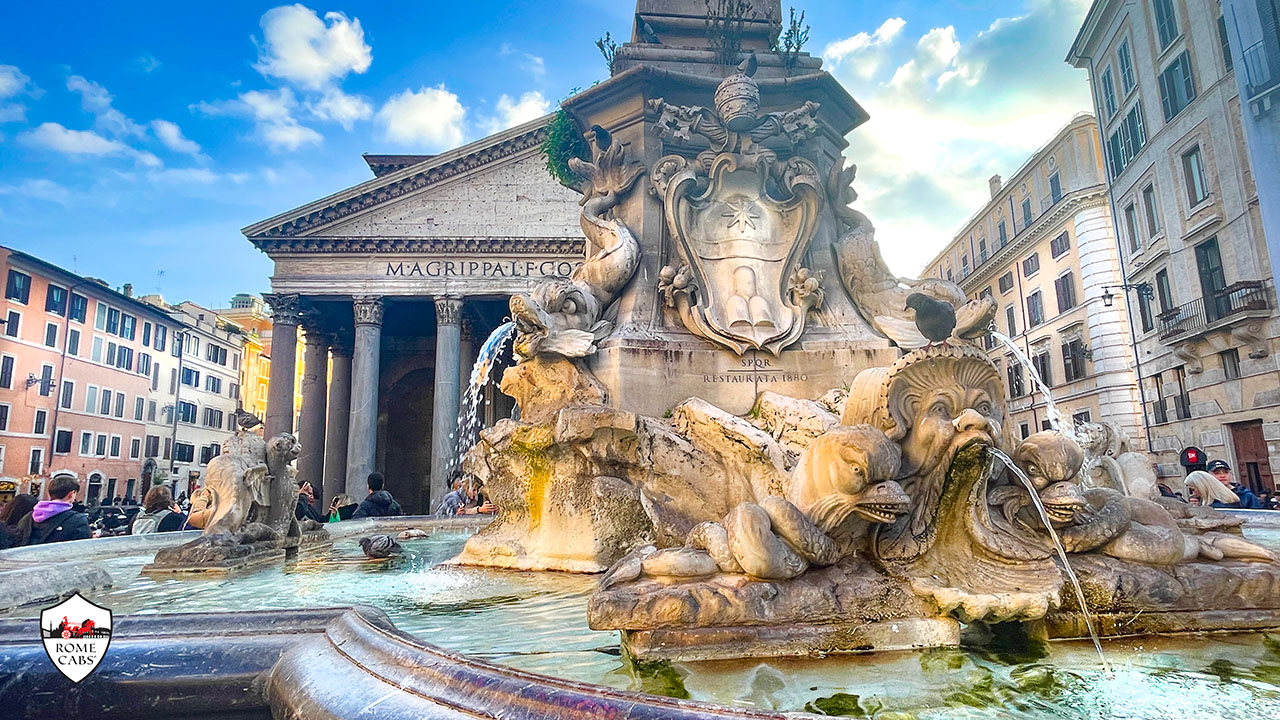
Fountain of the Pantheon
At the center of Piazza della Rotonda lies the Fountain of the Pantheon, a Baroque masterpiece created by the artist Giuseppe Piazza in 1575. This elegant fountain features an obelisk, which was originally erected in Heliopolis, Egypt, by the Pharaoh Seti I and later brought to Rome by Emperor Augustus.
The fountain’s design incorporates various sculptures, including a central figure of a dolphin and a triton, symbolizing the union of Roman engineering and artistic flair.
Trevi Fountain – A Masterpiece of Baroque Art
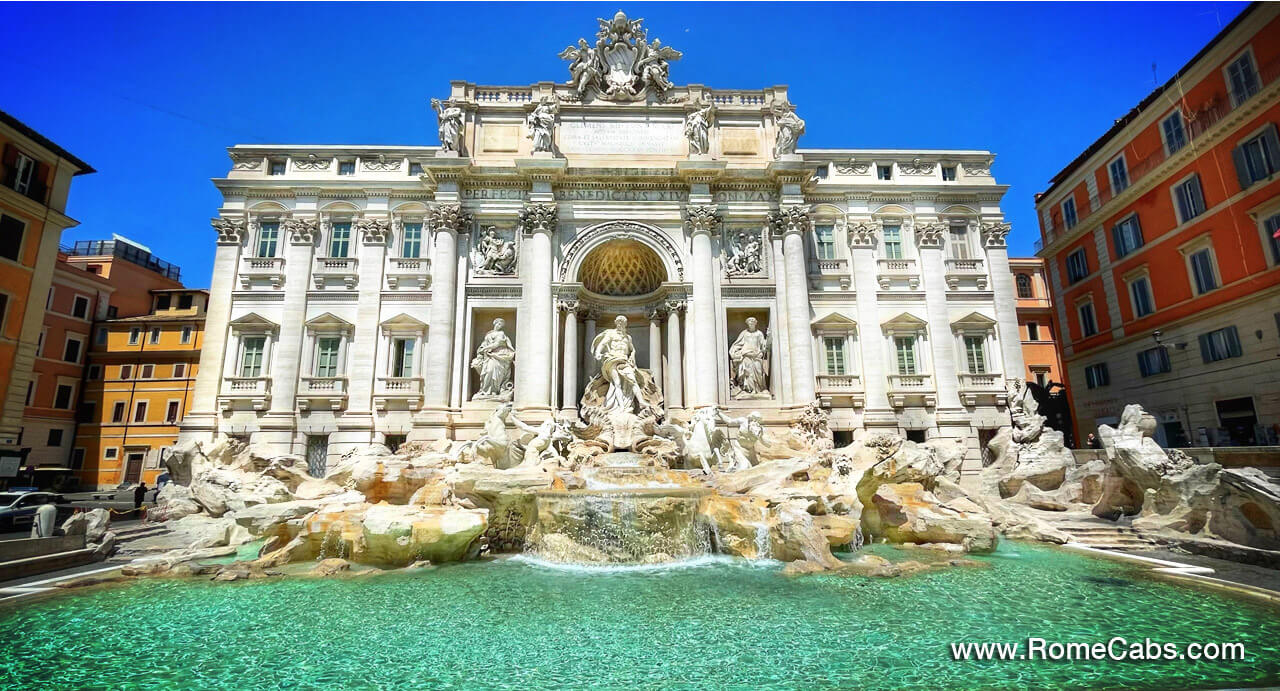
The Trevi Fountain is one of Rome’s most beloved landmarks, and for good reason. As the largest and most famous Baroque fountain in the city, it stands as a symbol of Rome’s artistic and architectural excellence.
Located at the intersection of three streets (hence the name “Trevi“), this magnificent fountain is an essential stop on the RomeCabs Panoramic Tour, offering a perfect blend of beauty, history, and legend.
History of the Trevi Fountain
The origins of the Trevi Fountain can be traced back to ancient Rome. The fountain sits at the terminus of the Acqua Vergine, one of the ancient aqueducts that supplied water to the city. The aqueduct was built in 19 BC by the Roman censor Marcus Vipsanius Agrippa to provide water to Rome’s growing population.
The fountain was originally designed in the 16th century, but it was not until the 18th century that it was completed in its current Baroque style by architect Nicola Salvi.
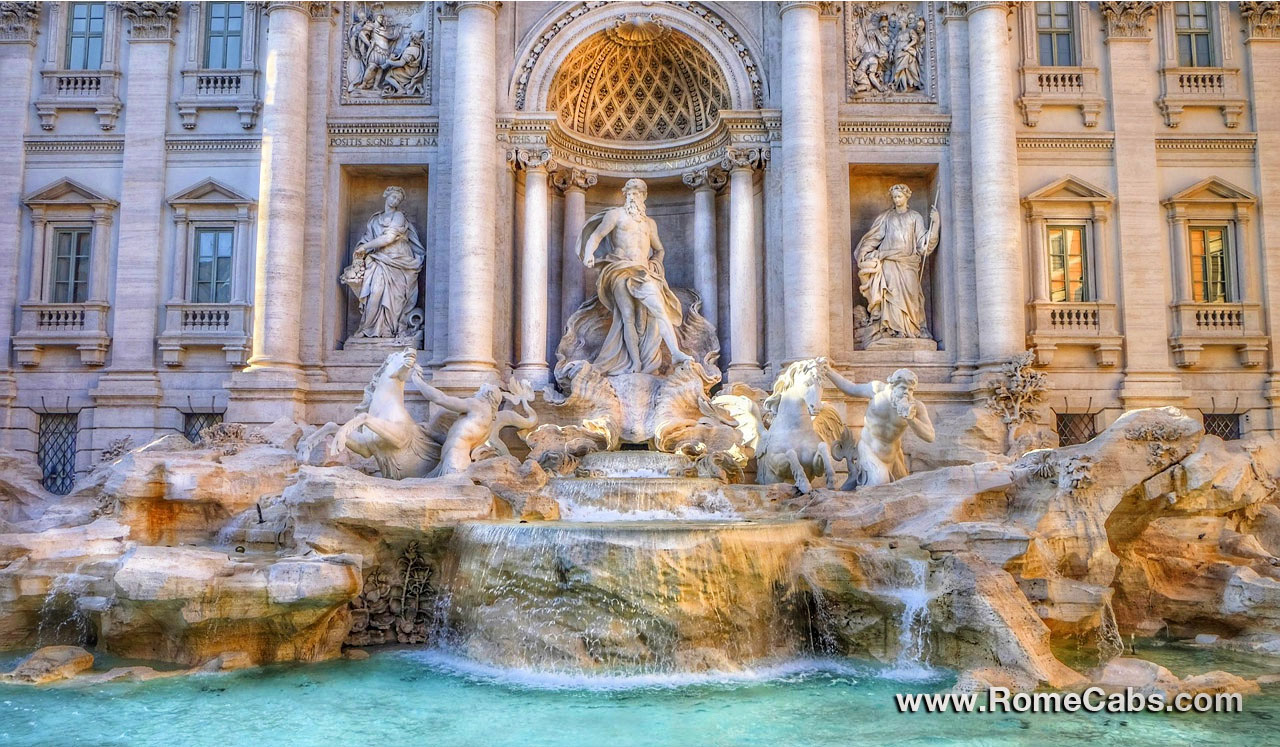
Salvi’s design was commissioned by Pope Clement XII, and construction took several decades, finally being completed in 1762 under the direction of Giuseppe Pannini. This lengthy construction process is a reflection of the grand vision behind the fountain and its integration with the surrounding Palazzo Poli. The fountain was originally meant to celebrate the restoration of the Acqua Vergine aqueduct, but it has since become a symbol of Rome’s artistic heritage and the grandeur of the Baroque period.
The Trevi Fountain is a breathtaking example of Baroque architecture, characterized by its dramatic sculptures, dynamic movement, and the interplay of water and stone. The central figure of the fountain is Oceanus, the Greek god of the sea, who is depicted riding a chariot shaped like a shell, pulled by two horses. These horses represent the contrasting aspects of the sea—one calm and docile, the other wild and tempestuous.

Flanking Oceanus are statues of Abundance and Salubrity, which symbolize the prosperity and health that the aqueduct brought to Rome. The water cascades over the rocky backdrop, creating a naturalistic effect that mirrors the flow of a river. The Baroque emphasis on movement is evident in the way the water seems to surge forward from the fountain’s base, enveloping the figures and giving the impression of constant motion.
The Palazzo Poli, which serves as the architectural backdrop for the fountain, adds to the grandeur of the scene. The building’s ornate facade complements the dynamic energy of the fountain, creating a cohesive visual experience that is both dramatic and harmonious. This integration of architecture, sculpture, and water is what makes the Trevi Fountain an enduring masterpiece of Baroque design.
Tradition of tossing a Coin into Trevi Fountain
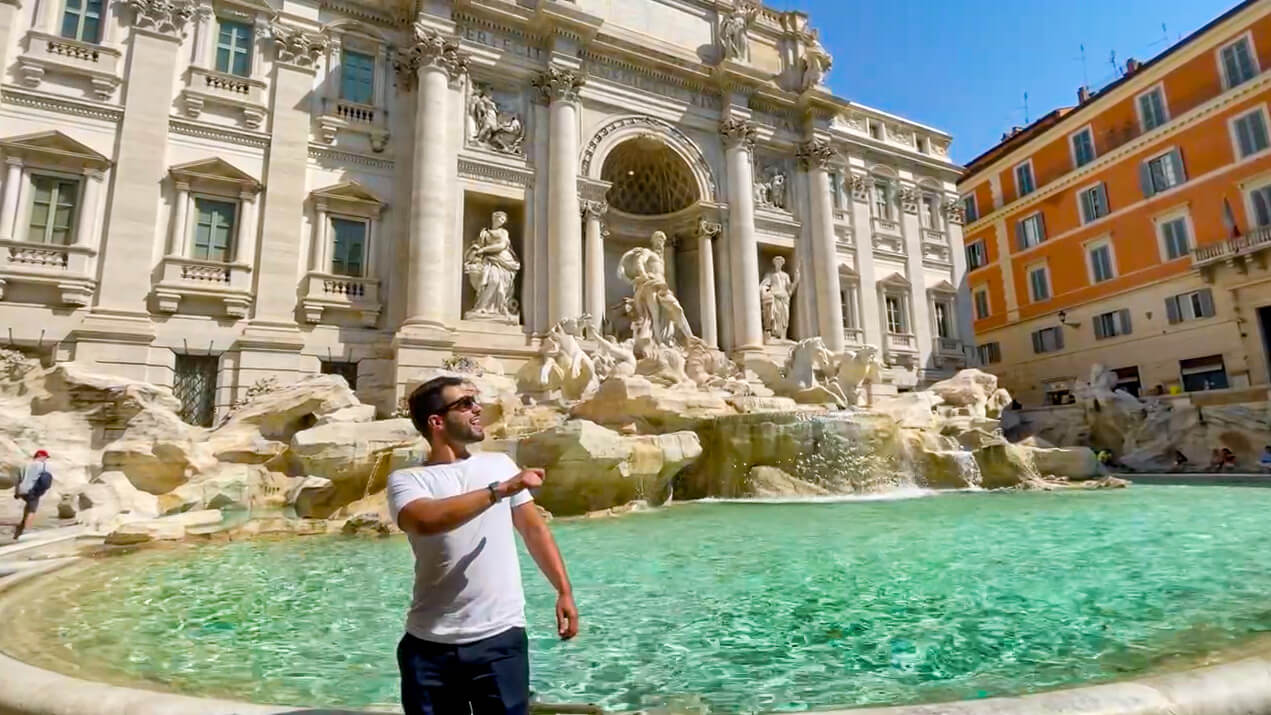
One of the most famous aspects of the Trevi Fountain is the tradition of tossing a coin into its waters. According to legend, throwing a coin with your right hand over your left shoulder ensures that you will return to Rome one day. It is estimated that around €1.5 million in coins are thrown into the fountain each year, which are collected and donated to charity. The tradition not only adds to the romantic charm of the fountain but also ties the landmark to the idea of eternal return, reflecting the timeless nature of Rome itself.
Spanish Steps – A Blend of Elegance and Roman Charm
The Spanish Steps (Scalinata di Spagna) are undoubtedly one of Rome’s most iconic and recognizable landmarks. This grand staircase, with its 135 steps, elegantly connects the Piazza di Spagna to the Trinità dei Monti church at the top, offering both a stunning architectural feature and a beloved gathering place for visitors and locals alike.
Whether you’re exploring Rome for the first time or returning to relive the magic of the city, the Spanish Steps are an essential stop on the RomeCabs Panoramic Tour, offering an unforgettable combination of history, beauty, and Roman elegance.

The Spanish Steps were built in the 18th century, between 1723 and 1725, with funding from the French diplomat Étienne Gueffier. The steps were designed by architects Francesco de Sanctis and Alessandro Specchi, and were constructed to connect the Piazza di Spagna—named after the nearby Spanish Embassy—with the Trinità dei Monti church at the summit. The church, with its twin towers, was built in the late 1500s by the French, adding a distinct international influence to the area.
The staircase’s name, Spanish Steps, derives from the Spanish Embassy located in the square, reflecting the historical connection between Spain and the area. The design of the staircase itself was innovative for its time, featuring a series of wide, sweeping flights that create a dramatic effect, allowing visitors to pause at various levels and enjoy the panoramic views of the city below. The Baroque style of the stairs complements the surrounding architecture, contributing to the area’s timeless charm.
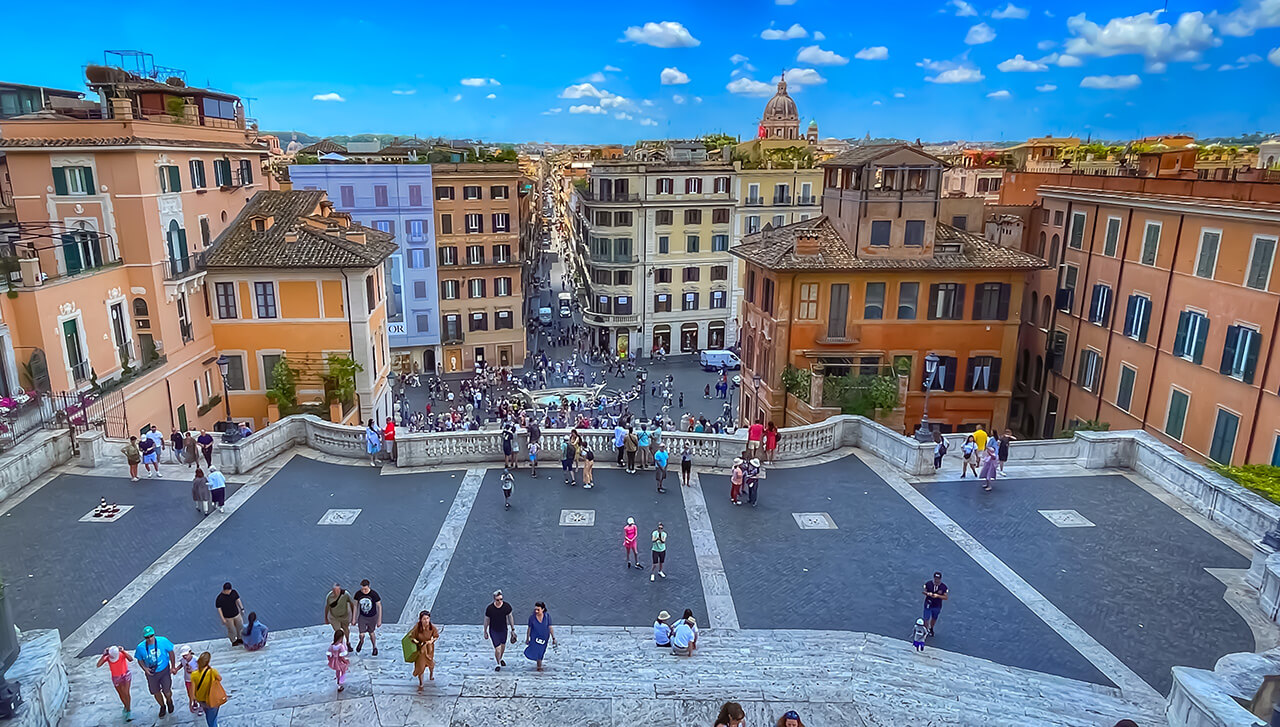
Fountain of the Old Boat (Fontana della Barcaccia)
At the base of the Spanish Steps, the Fountain of the Barcaccia, designed by Pietro Bernini and his son Gian Lorenzo Bernini, sits in Piazza di Spagna. This Baroque fountain, resembling a half-sunken boat, is a charming counterpoint to the grand staircase and adds another layer of beauty to the area.
The fountain’s design is inspired by a flood of the Tiber River that once occurred in the 16th century, which left a boat stranded in the piazza. The Fountain of the Barcaccia is a popular spot for visitors to stop and take a photo, especially in the summer months.

Beyond its architectural beauty, the area surrounding the Spanish Steps is known for its fashionable boutiques, luxury brands, and charming cafes, making it one of the most stylish spots in Rome.
Via Condotti, the fashionable street leading from the Spanish Steps, is lined with high-end fashion stores such as Gucci, Prada, and Cartier, attracting fashion-conscious visitors from all over the world. The lively atmosphere of the square, filled with both locals and tourists, makes it an excellent place to experience the essence of Roman life.

The Spanish Steps have long been a gathering place for artists, poets, and intellectuals, and continue to be a place where visitors can sit and soak in the beauty of Rome. Whether you’re admiring the view of the Piazza di Spagna below, people-watching in the vibrant piazza, or relaxing on the steps like generations before you, this landmark captures the spirit of La Dolce Vita in the heart of Rome.
Piazza Navona – Rome’s Baroque Masterpiece
Piazza Navona is one of Rome’s most stunning and historically rich squares, offering visitors a captivating glimpse into the city’s Baroque past. Located in the heart of Rome, Piazza Navona is not just a popular tourist destination, but also a testament to the artistic and architectural brilliance of the Baroque period.
As part of the RomeCabs Panoramic Tour, this lively square allows you to immerse yourself in the energy of Rome’s artistic heritage, surrounded by centuries-old fountains, churches, and the rich history that defined the city.

The square that is now Piazza Navona has its origins in ancient Rome. Originally constructed as a stadium, the Stadium of Domitian, during the reign of Emperor Domitian in the 1st century AD, it was used for athletic competitions and public events.
Over time, the stadium’s shape and the space it occupied evolved into the rectangular piazza we see today. While most of the ancient structure was eventually demolished, remnants of its original form can still be seen in the square’s elongated shape.
The transformation of Piazza Navona into a Baroque masterpiece began in the 16th century under the papacy of Pope Gregory XIII. However, it was during the 17th century, under the patronage of Pope Innocent X, that the piazza took on its present appearance, with the addition of several monumental fountains and the redesign of its buildings.
The most notable of these is the Fountain of the Four Rivers, created by the renowned artist Gian Lorenzo Bernini.
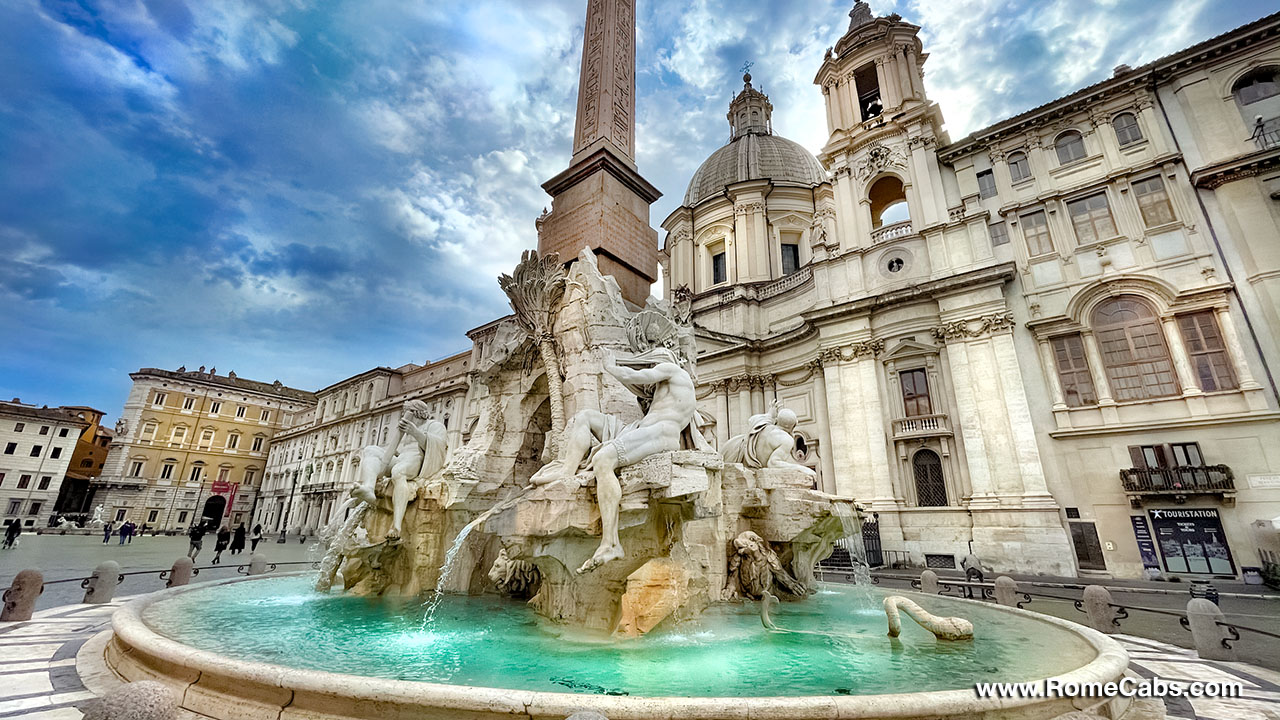
The Fountain of the Four Rivers: A Baroque Triumph
At the center of Piazza Navona stands the magnificent Fountain of the Four Rivers (Fontana dei Quattro Fiumi), one of Bernini’s greatest masterpieces. Completed in 1651, the fountain symbolizes the four major rivers of the known world at the time: the Nile, Ganges, Danube, and Rio de la Plata.
Bernini’s dramatic design features four imposing river gods, each representing one of these rivers, stretching across the fountain in powerful, dynamic poses.
At the top of the fountain, an obelisk, brought to Rome from the Circus of Maxentius, adds vertical drama to the structure, further emphasizing the grandeur of Bernini’s vision.

In addition to the Fountain of the Four Rivers, Piazza Navona is home to two other remarkable fountains: the Fontana del Moro at the southern end and the Fontana di Nettuno at the northern end. Both were designed by Giacomo della Porta and later enhanced by Bernini.
The Fontana del Moro, depicting a Moorish figure battling a dolphin, adds an exotic touch to the piazza’s classical beauty, while the Fontana di Nettuno showcases the god of the sea in a more playful, elegant manner.
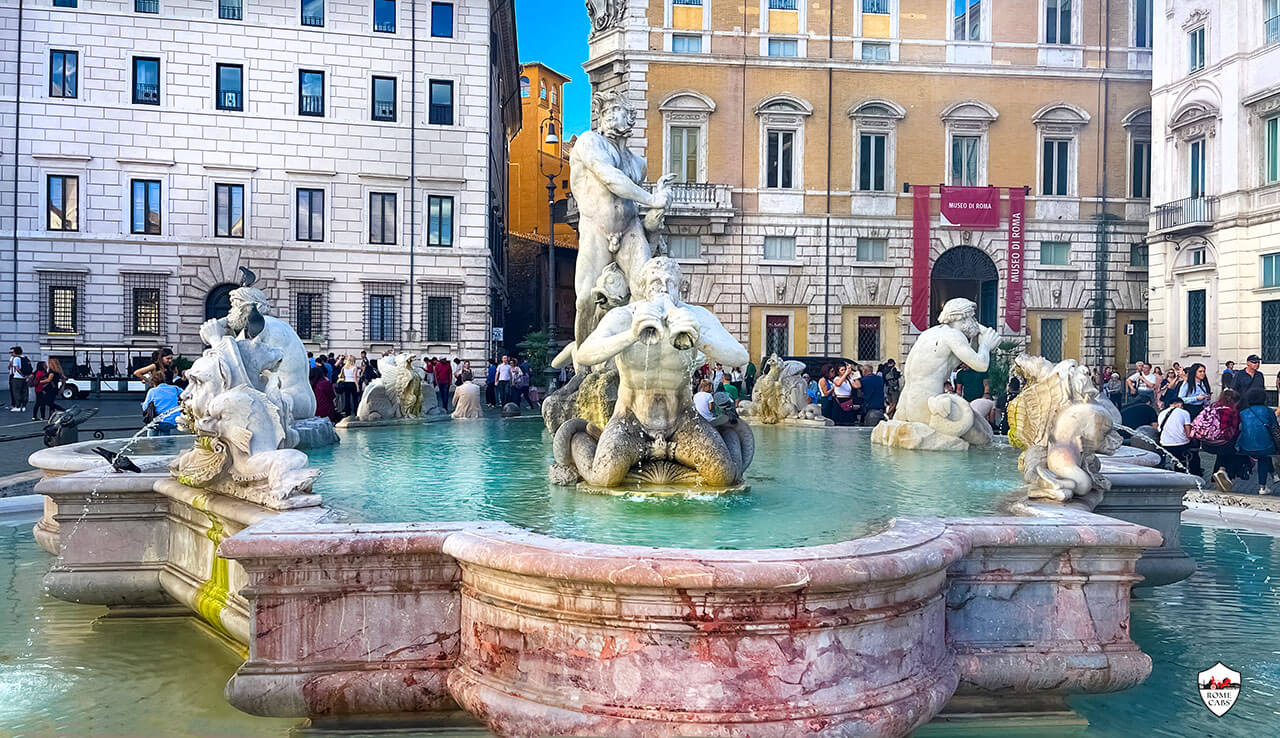
The square is also bordered by important buildings, including the Church of Sant’Agnese in Agone, designed by Francesco Borromini and Gian Lorenzo Bernini. This church, with its stunning dome and intricate façade, serves as a striking counterpoint to the grand fountains of the square, contributing to the overall harmony and balance of Piazza Navona.
Today, Piazza Navona is not only a historical and architectural gem but also a vibrant cultural hub. The square is filled with lively cafés, art vendors, and street performers, creating a dynamic and ever-changing atmosphere that captures the essence of Roman life. Visitors can enjoy the piazza’s beauty while soaking in its artistic heritage, making it one of the most beloved spots in Rome.
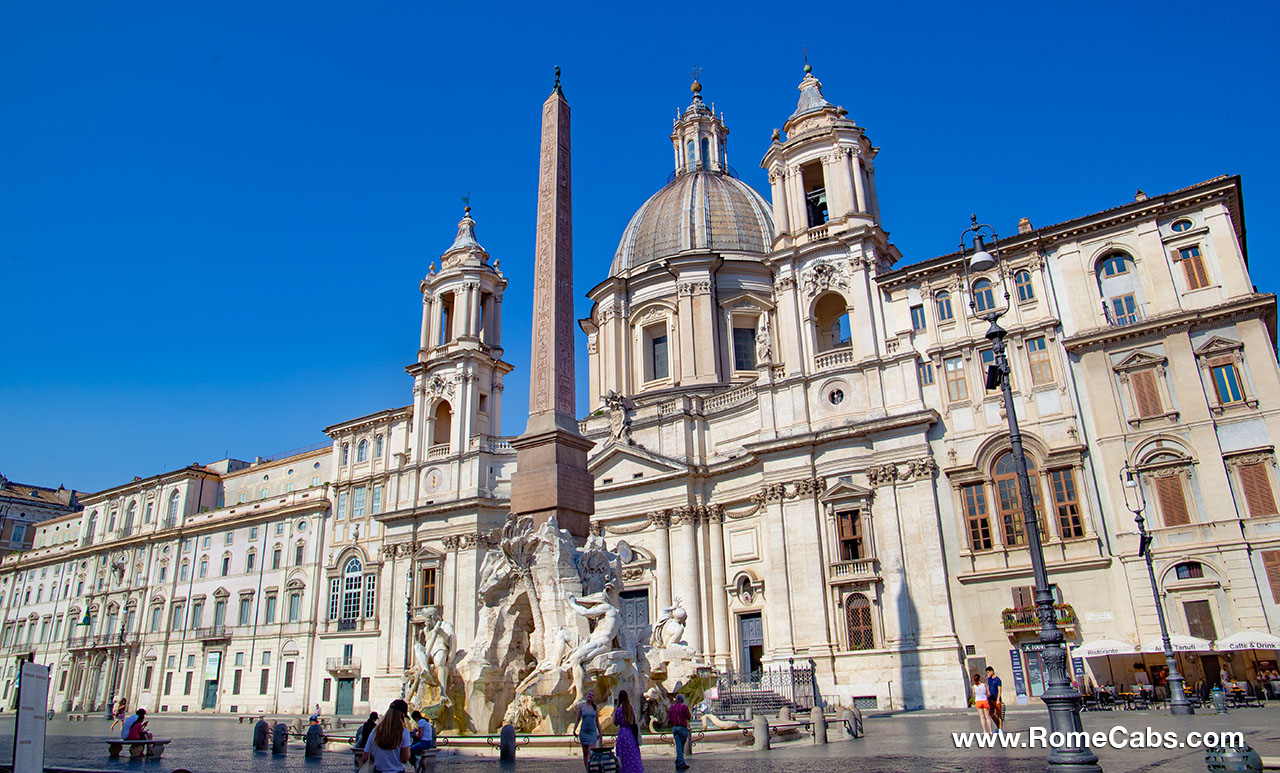
St. Peter’s Square – A Sacred and Majestic Landmark
No visit to Rome is complete without stepping into the awe-inspiring St. Peter’s Square (Piazza San Pietro), one of the most iconic and spiritually significant spaces in the world. Located at the heart of the Vatican, the square serves as the grand entrance to St. Peter’s Basilica, the epicenter of Catholicism and one of the most important religious buildings in the world.
As part of the RomeCabs Panoramic Tour, a stop at St. Peter’s Square provides not only a chance to experience its monumental beauty but also an opportunity to reflect on its profound cultural and religious significance.

The design of St. Peter’s Square was envisioned by the celebrated Baroque architect Gian Lorenzo Bernini in the 17th century, under the commission of Pope Alexander VII. Bernini’s design, completed between 1656 and 1667, reflects the Baroque ideals of grandeur, emotion, and movement, transforming the square into a dramatic, welcoming space for pilgrims and visitors from around the world.
One of the most remarkable features of St. Peter’s Square is its colonnade—a massive semicircular arrangement of 284 Doric columns, which encircle the square like open arms. These columns, with their distinctive and elegant design, create a sense of embrace, symbolizing the Church’s welcoming of all humanity.
The colonnade is flanked by 140 statues of saints, which seem to stand watch over the faithful and visitors alike. When viewed from the center of the square, the colonnade creates a sense of unity and connection, reinforcing the spiritual significance of the area.

The Obelisk and the 2 Fountains of St Peter’s Square
In the center of St. Peter’s Square stands an ancient Egyptian obelisk, which dates back to 13 BC. Originally erected in Heliopolis by the Egyptian Pharaoh Seti I, this obelisk was later moved to Rome by Emperor Caligula in 37 AD. It was eventually relocated to St. Peter’s Square in 1586 by Pope Sixtus V, who wanted to position it as a focal point of the square.
The obelisk is a striking feature, towering over the square at nearly 25 meters in height, and stands as a symbol of both Roman engineering prowess and the connection between ancient and Christian Rome.
Flanking the obelisk are two fountains, both designed by Carlo Maderno and Gian Lorenzo Bernini. The fountain on the left, built in 1613, is larger and more ornate, while the one on the right, added in 1675, is simpler but equally elegant.
These fountains, with their cascading waters, add to the tranquil yet majestic atmosphere of the square and enhance its Baroque aesthetic. The fountains not only provide a refreshing element to the design but also symbolize the flow of spiritual life and the nurturing of faith.

St. Peter’s Basilica – A Symbol of Power and Faith
As you stand in St. Peter’s Square, you’ll be overwhelmed by the grandeur of St. Peter’s Basilica looming in the background. The basilica’s monumental façade, designed by Carlo Maderno, is crowned by a series of statues of Christ and the Apostles, underscoring its sacred importance.
The basilica itself, designed by Michelangelo, is one of the largest churches in the world and a masterpiece of Renaissance architecture.
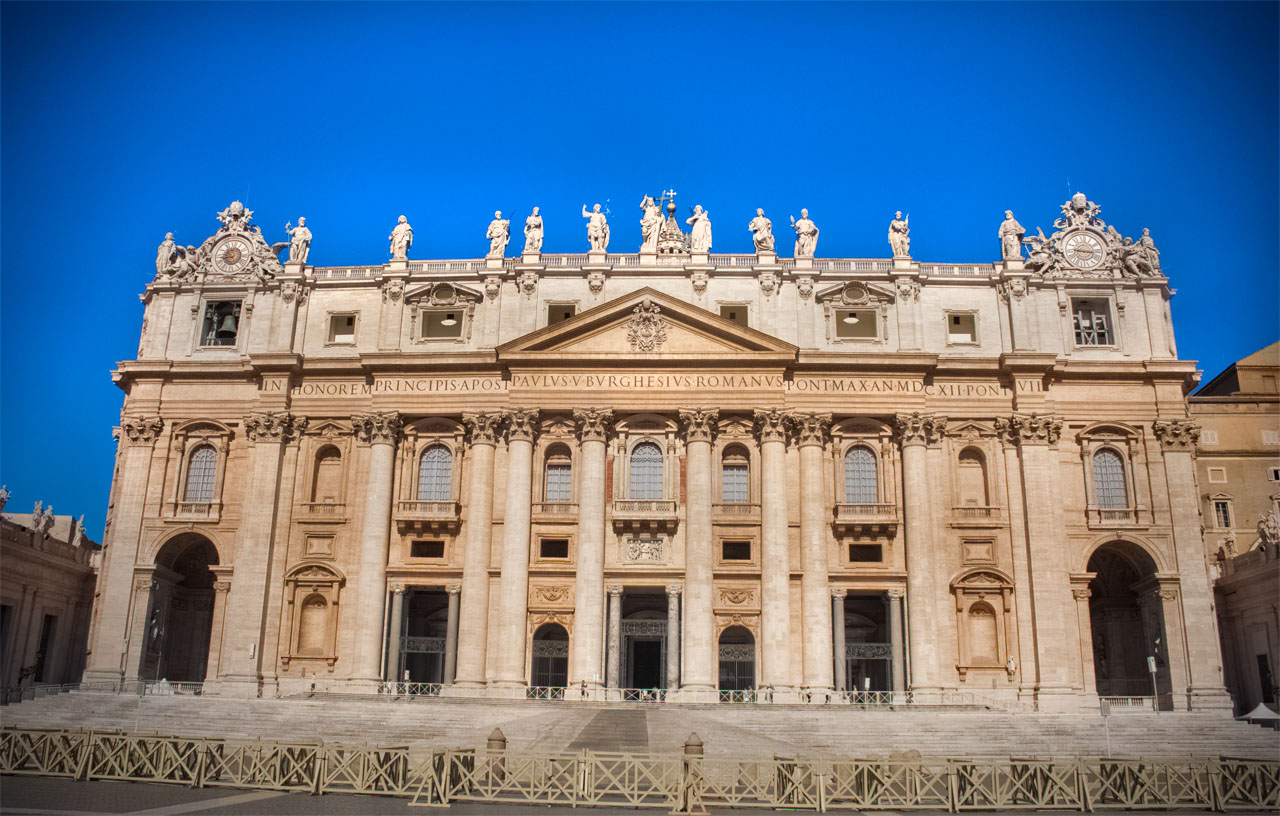
The sheer scale and beauty of St. Peter’s Basilica, with its iconic dome designed by Michelangelo, reflects the power and influence of the Vatican, both spiritually and politically. It is here, within the basilica, that the tomb of St. Peter, the first pope, lies beneath the high altar, marking the site as the center of Catholicism.
Capitoline Hill and the Roman Forum
As your RomeCabs Panoramic Tour continues, you will stop on top of Capitoline Hill for a panoramic view of the Roman Forum, the ancient heart of Rome’s public life. From the hill, you can look out over the sprawling ruins of temples, basilicas, and government buildings that once served as the political, social, and religious center of the Roman Empire. These ruins, though weathered by time, still speak to the grandeur of Roman civilization.
The Roman Forum includes iconic landmarks such as the Temple of Saturn, Temple of Vesta, and the Senate House. As you stand on Capitoline Hill, you can almost hear the echoes of ancient speeches made in the Senate and imagine the bustling life of Roman citizens who once gathered here for civic and religious duties.

Historically, Capitoline Hill was the religious and political hub of ancient Rome. It was home to the great Temple of Jupiter Optimus Maximus, dedicated to the king of the gods, which was one of the most important temples in the Roman world.
Over time, this hill became the focal point of Roman power and a symbol of Rome’s dominance in the ancient world. Even today, the hill remains a symbol of strength and governance.
The hill was the site of many pivotal events in Roman history, including triumphal processions for victorious generals and the swearing-in of newly elected officials. The Capitoline Hill also served as the home of the Roman Senate for centuries, and its significance is highlighted by the magnificent structures that surround it.

Colosseum Square – Witness to Ancient Rome’s Glory
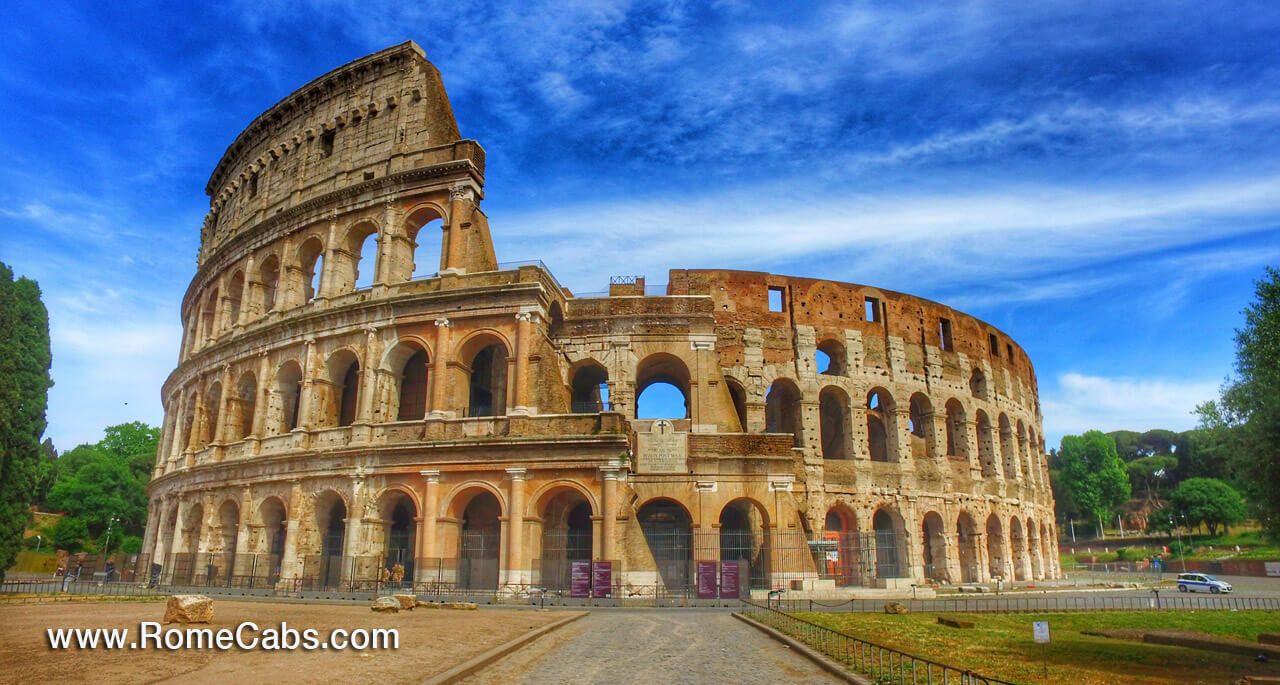
No visit to Rome is complete without encountering the colossal Colosseum, one of the most iconic symbols of ancient Rome and an architectural marvel that has captivated visitors for centuries. As part of the RomeCabs Panoramic Tour, you’ll have the opportunity to admire the Colosseum from the outside, gaining a sense of the grandeur and scale of this remarkable structure.
The Colosseum Square (Piazza del Colosseo) offers a stunning vantage point, allowing you to take in not only the immense size of the amphitheater but also the fascinating history that continues to echo through its walls.
The Colosseum: Engineering Brilliance and Ancient Spectacle
Constructed between 70 and 80 AD under the emperors Vespasian and Titus, the Colosseum is a testament to the engineering genius of ancient Rome. This elliptical amphitheater, capable of holding up to 50,000 spectators, was the stage for gladiatorial contests, mock naval battles, animal hunts, and public spectacles that entertained the Roman populace.
The Colosseum’s sophisticated design included an advanced system of retractable awnings, underground chambers for animals and gladiators, and a complex network of corridors to manage the flow of the audience. Its enduring legacy as a symbol of Roman power and entertainment has made it a UNESCO World Heritage Site and one of the world’s most recognized landmarks.
The exterior of the Colosseum, with its massive arches and tiered levels, still bears the marks of its long history, including damage from earthquakes and looting. Despite this, the Colosseum remains an awe-inspiring monument to the technological and cultural prowess of the Roman Empire.

Behind the Colosseum are the ruins of Ludus Magnus, the ancient Roman gladiator training school that had direct access to the arena of the Colosseum.
From Colosseum Square, you’ll be able to appreciate its immense scale and imagine the grand spectacles that once took place within its walls, echoing the might and ambition of Rome at the height of its power.

The Arch of Constantine: A Monument to Triumph
Standing proudly next to the Colosseum is the Arch of Constantine, a monumental triumphal arch erected in 315 AD to commemorate Emperor Constantine I’s victory over Maxentius at the Battle of Milvian Bridge in 312 AD.
This impressive structure, adorned with detailed reliefs and inscriptions, celebrates Constantine’s rise to power and marks a pivotal moment in Roman history—the beginning of the Christian era under Constantine’s rule.
The Arch of Constantine is notable for its fusion of architectural styles. It borrows elements from earlier triumphal arches, such as the Arch of Trajan and the Arch of Septimius Severus, creating a visual dialogue across different periods of Roman history.
Its intricate carvings depict not only the triumphs of Constantine but also earlier emperors, reflecting the emperor’s desire to align himself with the greatness of Rome’s past.

Together, the Colosseum and the Arch of Constantine encapsulate the grandeur and historical significance of ancient Rome. The Colosseum, once the site of brutal contests and celebrations of Roman might, now stands as a monument to human ingenuity and resilience.
Circus Maximus – The Thrilling Ancient Roman Entertainment
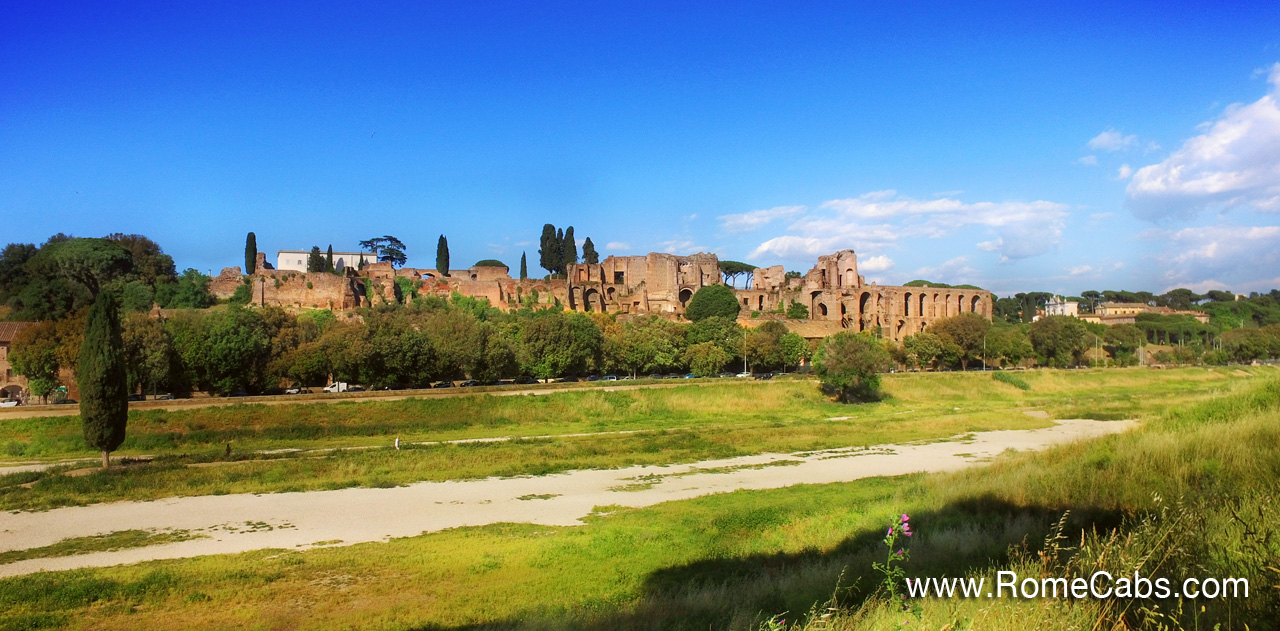
As your RomeCabs Panoramic Tour takes you past the Circus Maximus, you’re stepping into one of the most vibrant and exhilarating sites of ancient Rome. Once the largest and most prestigious racecourse in the Roman Empire, the Circus Maximus was the stage for thrilling chariot races and other public spectacles that drew immense crowds, capturing the imagination of the citizens and reflecting the grandeur of Rome’s imperial power.
Though today only ruins remain, the site continues to evoke the excitement and energy of an era where entertainment, politics, and spectacle were intertwined.
The History of Circus Maximus: The Epicenter of Roman Spectacle
The Circus Maximus dates back to the 6th century BC, with its origins attributed to the early kings of Rome. It was dramatically expanded and refurbished over the centuries, especially under the reigns of the Flavian emperors, who sought to enhance the grandeur of Rome’s entertainment venues.
At its peak, the Circus Maximus could hold up to 250,000 spectators, making it one of the largest entertainment venues ever built. For comparison, it could comfortably accommodate more than double the number of people who attended modern-day sporting events in colossal stadiums like the Coliseum.
The arena was primarily used for chariot races, but it also hosted other events such as gladiatorial games, wild animal hunts, and public celebrations. Chariot races, in particular, were the most popular, with teams of horses racing around the track in a dangerous, high-speed competition that captivated the masses.

The Spectacular Architecture and Layout of the Circus Maximus
The Circus Maximus was a remarkable feat of Roman engineering. Stretching nearly 600 meters in length and 150 meters in width, the track was laid out in a long, oval shape, with high embankments on either side for spectators.
The central divider, known as the spina, was adorned with statues, obelisks, and fountains, all of which added to the spectacle and grandeur of the races. A key feature of the spina was the metae—the turning points—where chariots would race at incredible speeds, often colliding or crashing, making for intense and dramatic moments.
Although much of the stone structure has been lost to time and the site is now mostly open ground, the outlines of the track and some remnants of the seating areas can still be discerned.
Even though the Circus Maximus itself has been lost to time and no longer exists apart from few remnants, its legacy lives on as a symbol of the exuberant public life of ancient Rome.
Today, the site serves as a park and is occasionally used for large-scale events and concerts, but it remains a reminder of the Roman thirst for spectacle and the role that entertainment played in the heart of their society.
Stopping at the Circus Maximus during your RomeCabs Panoramic Tour allows you to imagine the roar of the crowds, the dust kicked up by the racing horses, and the immense excitement that once filled this ancient venue.
Basilica of Saint Paul Outside the Walls
The final stop on your RomeCabs Panoramic Tour is the awe-inspiring Basilica of Saint Paul Outside the Walls (Basilica di San Paolo Fuori le Mura), one of the four papal basilicas of Rome and a must-see for those looking to delve into the spiritual and historical heritage of the city.
This monumental church, dedicated to the Apostle Saint Paul, stands as a testament to the rich Christian heritage of Rome, offering both an architectural marvel and a peaceful sanctuary for contemplation. Located just outside the Aurelian Walls, the basilica holds a special place in the hearts of pilgrims and visitors alike.

A Historic Site of Faith and Devotion
The Basilica of Saint Paul Outside the Walls was originally built in the early 4th century by Emperor Constantine I, and it is said to mark the site where Saint Paul was buried after his martyrdom in 67 AD.
Over the centuries, the basilica has undergone various reconstructions and restorations, particularly following a devastating fire in 1823 that nearly destroyed the church.

Despite these changes, the basilica has retained its essential beauty and significance, making it a vital pilgrimage site for Catholics and a cherished historical landmark for visitors from all over the world.
The basilica’s dedication to Saint Paul, the great missionary and theologian, reflects its role in honoring the apostle’s contribution to the spread of Christianity.
Saint Paul, known for his letters that form a significant portion of the New Testament, is depicted in the mosaics and artwork throughout the church, underscoring his enduring influence on Christian theology and doctrine.
Majestic Architecture and Sacred Atmosphere
The basilica’s architecture is a striking example of early Christian and Byzantine styles, blending Romanesque elements with the classical traditions of ancient Rome. The façade, which was rebuilt in the 19th century, features a grand entrance with a stunning portico that welcomes visitors into the church’s vast interior.
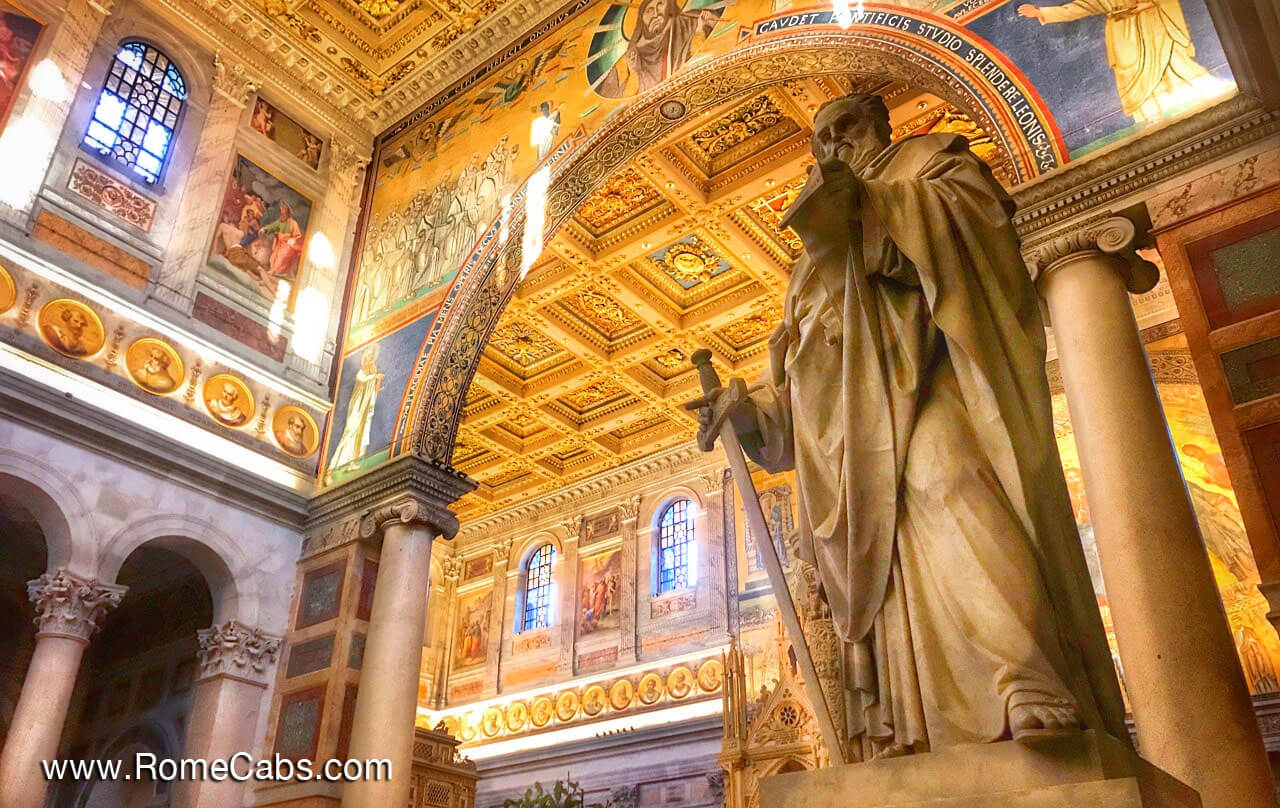
Inside, the spacious nave is supported by magnificent granite columns, while the golden mosaics above the altar depict the apostle’s life and work, portraying him in glorious and vibrant scenes.

The church is particularly famous for its beautifully preserved mosaic of the Triumph of Saint Paul, which adorns the apse. This mosaic, created in the 13th century, depicts Saint Paul surrounded by angels, a powerful reminder of his role in Christian history.
Visitors can also marvel at the basilica’s stunning stained glass windows and intricate marble floors, which contribute to the tranquil and reflective atmosphere that defines the space.
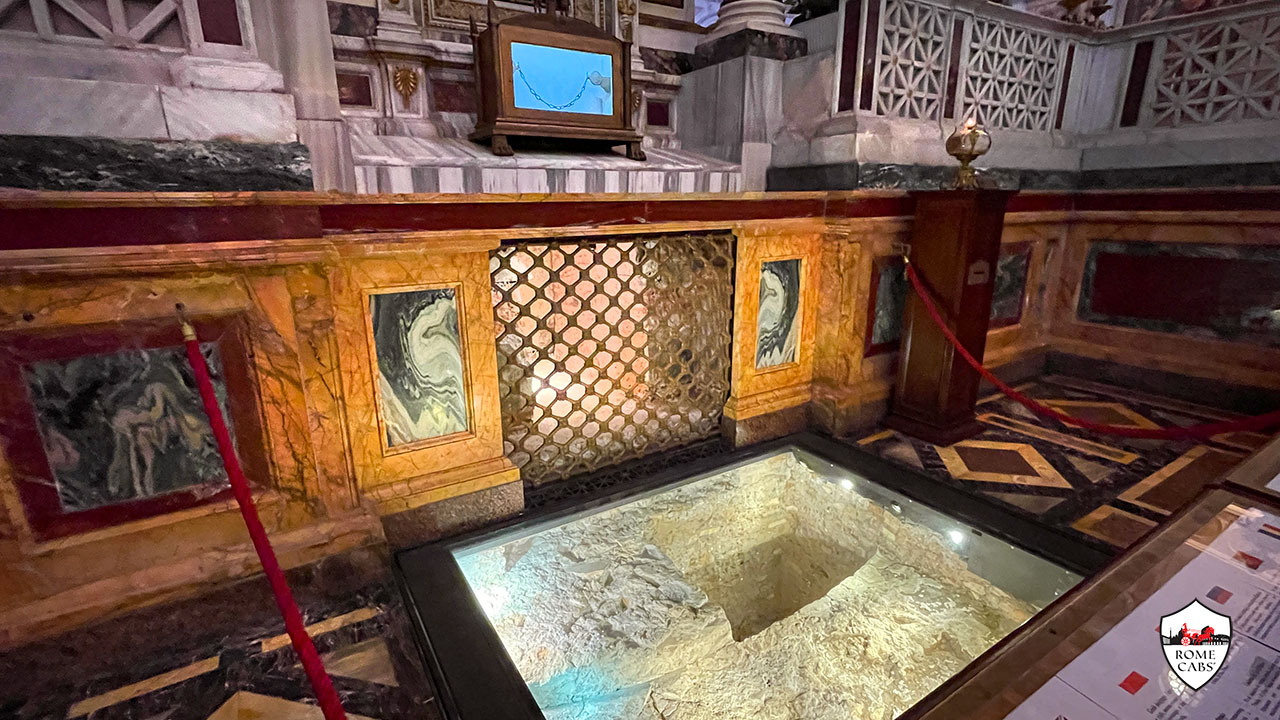
One of the basilica’s most remarkable features is the crypt beneath the altar, where the tomb of Saint Paul is located. The tomb is a place of deep reverence, and pilgrims come from around the world to pray and reflect on Saint Paul’s legacy. The crypt also houses the “Chains of Saint Paul”, relics that are believed to have been used to imprison the apostle before his execution.
This tour is also available as a Shore Excursion from Civitavecchia: Panoramic Rome for Cruisers from Civitavecchia and as a Panoramic Rome Post-Cruise Tour from Civitavecchia at the conclusion of a cruise with pick up at the cruise port and drop off at Rome hotel.
Why book RomeCabs for Rome Tours and Shore Excursions from Civitavecchia?
RomeCabs has been a trusted name in the travel industry since 2004, pioneering Rome tours by car and providing exceptional service for over 20 years. Renowned for our dedication to excellence, we have built a strong reputation as one of the leading providers of private tours and transfers in Rome.
RomeCabs Deluxe Vehicles for Ultimate Comfort
When you choose RomeCabs, you are choosing comfort, style, and reliability. Our Deluxe Mercedes vehicles are meticulously maintained to provide you with the highest level of comfort, ensuring a smooth and pleasant ride throughout your tour. Whether you’re traveling solo, with a partner, or in a small group, our luxury vehicles provide the perfect environment to relax and take in Rome’s spectacular sights without any stress.

Experienced, Knowledgeable English-speaking RomeCabs Drivers
RomeCabs’ English-speaking drivers are more than just drivers—they are knowledgeable professionals who understand the ins and outs of Rome and its history. They’ll take you to the most iconic sites and offer insightful information along the way, enhancing your experience without the crowds or rigid schedules of group tours.
They will also ensure you get as close as the law allows to each destination, reducing the amount of walking required, which is especially valuable on long or busy sightseeing days.
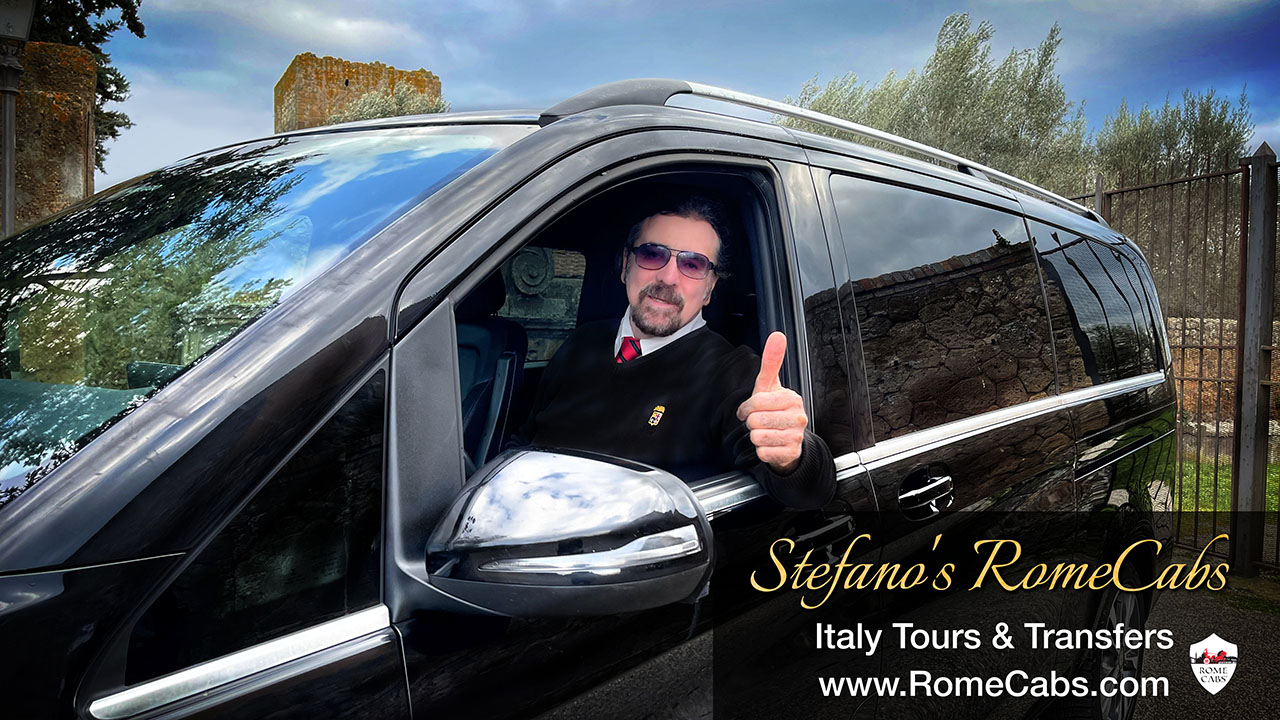
Thousands of 5-Star RomeCabs Reviews: Trust and Reliability
The thousands of 5-star reviews we’ve received on RomeCabs Tours and Transfers reflect our unwavering dedication to providing exceptional customer service.
RomeCabs’ clients appreciate not only the luxury and convenience of our services but also the professionalism and expertise of our drivers. Whether it’s a sightseeing tour, a private transfer, or a special request, we pride ourselves on delivering memorable experiences tailored to your needs.
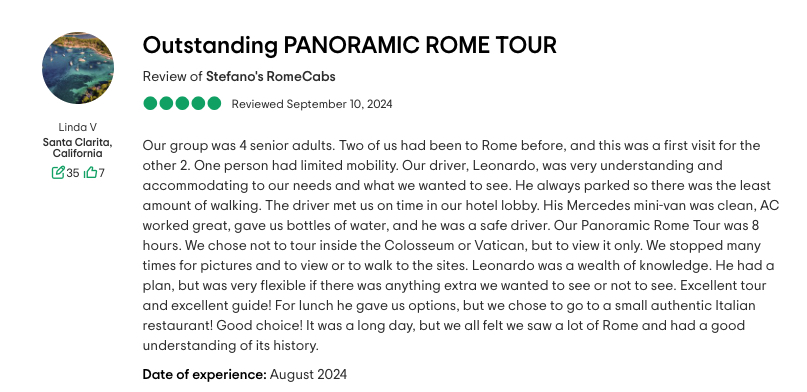
Linda V from Santa Clarita, California wrote:
Outstanding PANORAMIC ROME TOUR
Our group was 4 senior adults. Two of us had been to Rome before, and this was a first visit for the other 2. One person had limited mobility. Our driver, Leonardo, was very understanding and accommodating to our needs and what we wanted to see. He always parked so there was the least amount of walking. The driver met us on time in our hotel lobby. His Mercedes mini-van was clean, AC worked great, gave us bottles of water, and he was a safe driver. Our Panoramic Rome Tour was 8 hours. We chose not to tour inside the Colosseum or Vatican, but to view it only. We stopped many times for pictures and to view or to walk to the sites. Leonardo was a wealth of knowledge. He had a plan, but was very flexible if there was anything extra we wanted to see or not to see. Excellent tour and excellent guide! For lunch he gave us options, but we chose to go to a small authentic Italian restaurant! Good choice! It was a long day, but we all felt we saw a lot of Rome and had a good understanding of its history.

Robert S from Tennessee wrote:
Excellent does not begin to describe Romecabs
“Excellent” does not begin to describe the service provided by RomeCabs. We used them for three pickup/transfer/tour options and can not say enough good things about them. We first booked them to pick us up when we arrived at the Rome airport to include a 4 hour driving tour. Our guide first asked us what were were seeing while we were in Rome and then he proceeded to take us to places we would not get to see. The “driving tour” isn’t just a ride and see but included stopping and getting out to tour various places along the way. Next we booked the Rome hotel to cruise port transfer. Despite this only being a transfer, the driver spoke very good English and told us about various things/places as we drove to the port. Lastly, we booked the post cruise port pick up and country side tour. Again, excellent driver/guide, very accommodating, friendly, and professional. Before we booked our tours/pickups we compared prices from the top three companies in Rome. RomeCabs had the best reviews, best prices, and allowed us to pay for our bookings prior to arriving in Rome. Their competitors did not mention that option and wanted payment in Euros in person (we weren’t crazy with the idea of carrying that much money in cash). Also, the vans they picked us up in had plenty of room, were very clean, and comfortable. Definitely use RomeCabs when you are in Rome!!
Choosing RomeCabs means choosing a service that has been trusted by travelers for two decades, ensuring that your time in Rome will be as enjoyable, comfortable, and unforgettable as possible.
Find RomeCabs also online:
Facebook: https://www.facebook.com/RomeCabsToursAndTransfers
RomeCabs Pinterest: https://www.pinterest.it/romecabs
RomeCabs Twitter: https://twitter.com/RomeCabs
RomeCabs Instagram: https://www.instagram.com/romecabs/
RomeCabs Flickr Photo Gallery: https://www.flickr.com/photos/romecabs/
Discover MORE of Rome with RomeCabs Travel Blogs!

 RomeCabs Blog Italy - Italy Private Excursions, Rome Tours, Civitavecchia Transfers